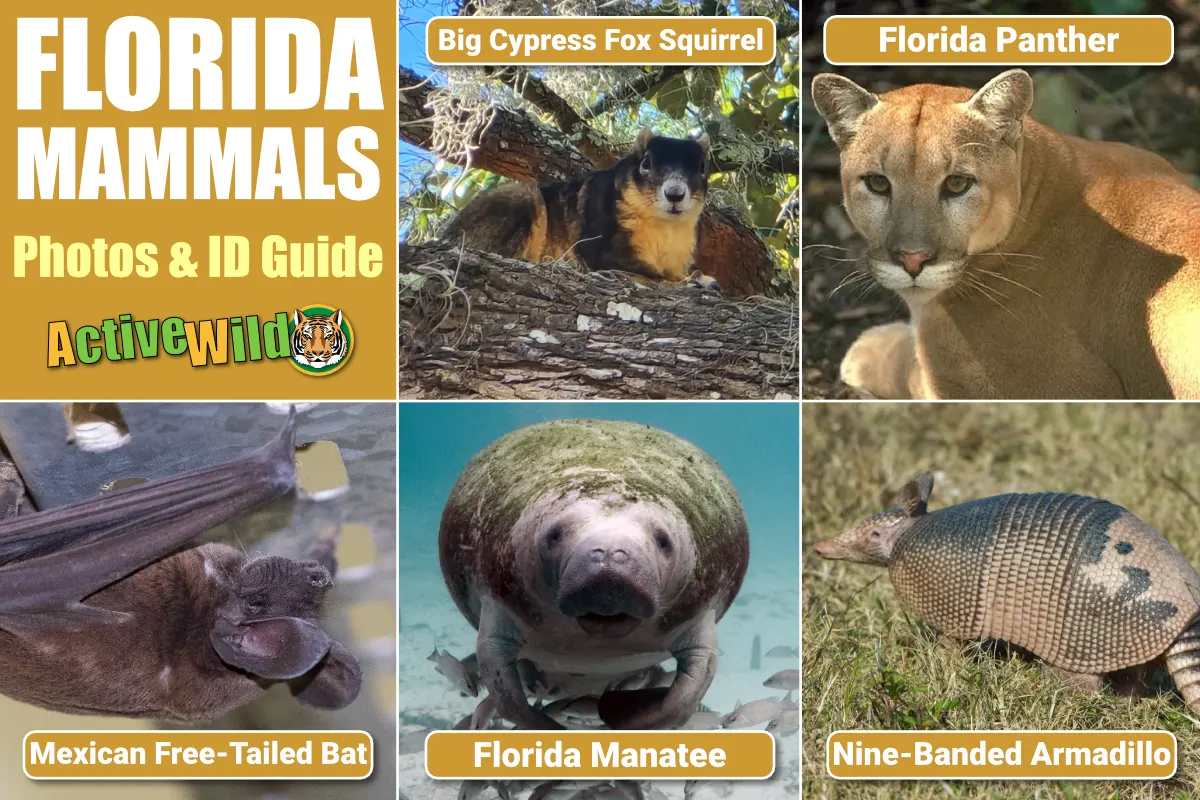
Florida is home to a diverse array of mammals that reflect the state’s unique ecosystems, from coastal wetlands to pine forests. This article highlights a selection of especially characteristic, iconic, or regionally notable species and subspecies found in Florida.
Included below are species such as the Florida Panther, an emblematic large carnivore, and the West Indian Manatee, a distinctive marine mammal.
Other notable mammals covered include the Big Cypress Fox Squirrel, Florida Black Bear, and Florida Key Deer, each playing important roles in their habitats.
Together, these species offer insight into Florida’s rich natural history and wildlife diversity.
Have you seen any of these mammal species in Florida? Help bring this page to life with your own observations, thoughts and questions in the comments section at the bottom of the page – we’d love to hear from you!
The Active Wild Team
Page Index
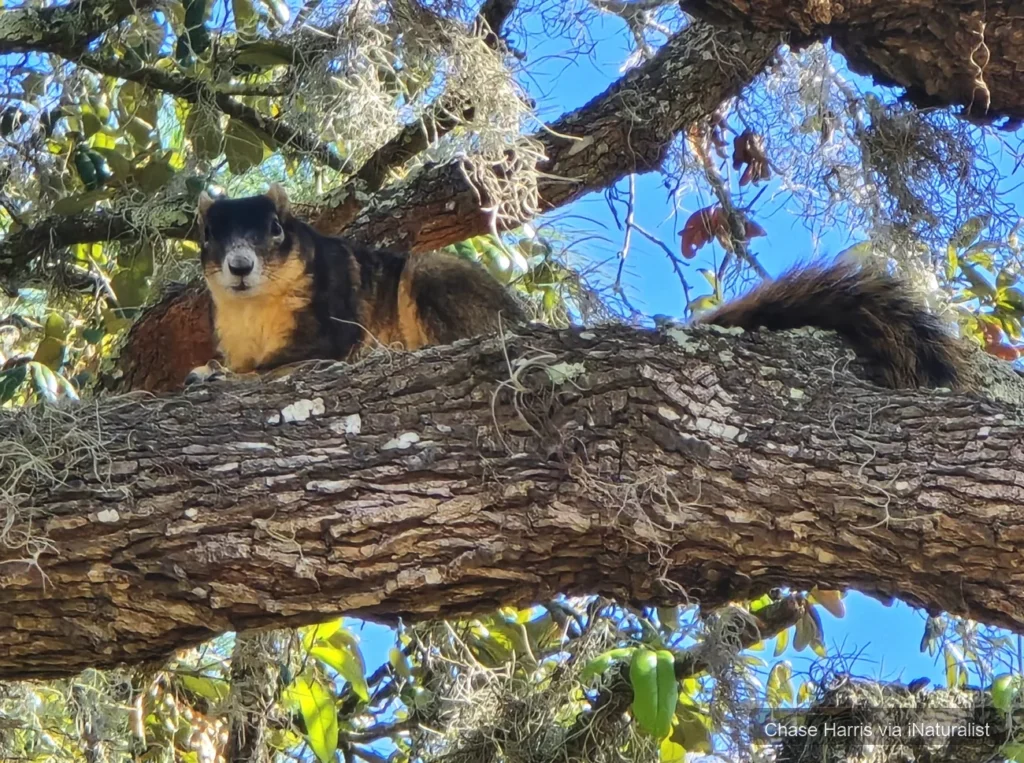
Big Cypress Fox Squirrel
- Scientific name: Sciurus niger avicennia
- Family: Sciuridae
- Rank: Subspecies
The Big Cypress Fox Squirrel is a subspecies of fox squirrel notable for its large size and distinctive coloration. It has a mostly orange-brown / gray body (dark gray / black in some populations) with a white belly and white fur around the eyes. Its bushy tail is also gray with white edges. Adults typically measure between 20 and 30 inches in total length, including the tail.
This squirrel is found primarily in the Big Cypress National Preserve and surrounding areas in southern Florida. It prefers pine flatwoods, cypress swamps, and hardwood forests where it nests in large trees.
This Florida mammal is often seen on the ground or in low branches, where its size and unique coloration help distinguish it from other tree squirrels (the fox squirrel is the largest tree squirrel in the USA).
Eastern Gray Squirrel

- Scientific name: Sciurus carolinensis
- Family: Sciuridae
- Rank: Species
This medium-sized tree squirrel measures about 16 to 20 inches in total length, including its bushy tail. It has a rounded body with soft gray fur on its back and sides, often mixed with hints of brown, and a white or light gray belly. The tail is large and bushy, usually the same gray color as the body with a slightly lighter underside. Its ears are small and rounded without prominent tufts.
In Florida, this squirrel is common in urban parks, suburban areas, and woodlands, often seen near oak and pine trees where it forages for nuts and seeds. It is active during the day and frequently spotted running along branches or on the ground. This species is notable in the region for its adaptability to various habitats and its role in seed dispersal, helping maintain local ecosystems.
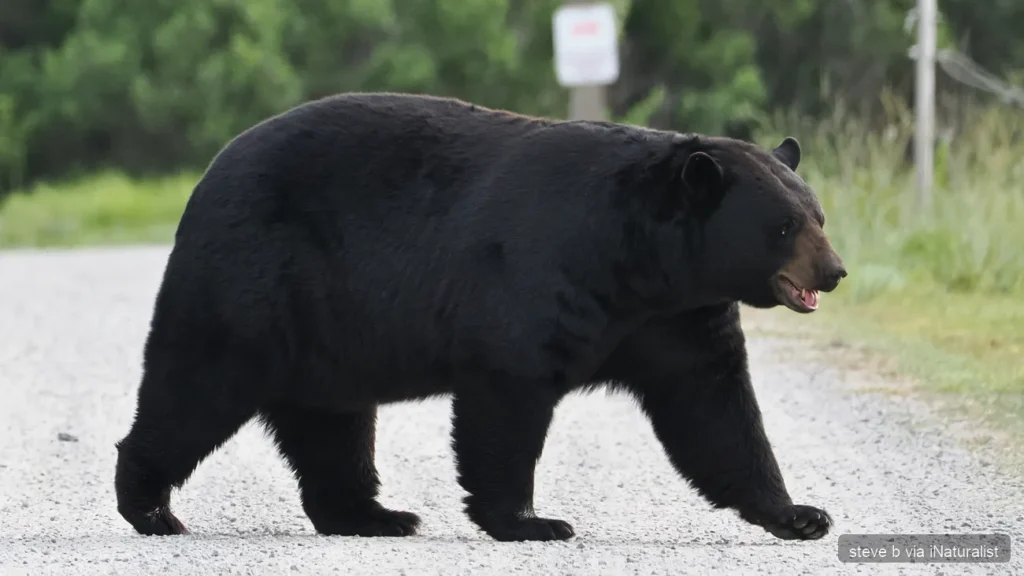
Florida Black Bear
- Scientific name: Ursus americanus floridanus
- Family: Ursidae
- Rank: Subspecies
The Florida Black Bear is a black bear subspecies found in Florida and neighboring states. It has a solid black coat that covers its stocky body, with some individuals having a white patch (known as a “blaze”) on the chest. It typically measures 4 to 6 feet in length from head to tail, with males larger than females. The bear’s broad shoulders and powerful limbs give it a robust silhouette.
This subspecies inhabits diverse forested areas throughout Florida, including hardwood swamps, pine flatwoods, and mixed forests. It is most often encountered in remote natural preserves or less developed rural areas.
The Florida Black Bear is the only bear native to Florida, where it plays a key role in maintaining ecosystem balance by dispersing seeds and controlling insect populations. Its presence reflects the health of Florida’s wild habitats.
Florida Bonneted Bat
(No photo available)
- Scientific name: Eumops floridanus
- Family: Molossidae
- Rank: Species
Found primarily in South Florida, the Florida Bonneted Bat inhabits subtropical woodlands, urban parks, and areas with large trees or buildings where it can roost. It is the largest bat species in Florida, with a wingspan of about 16 to 19 inches and a body length around 5 inches. The bat has dark brown to black fur and a distinctive broad, bonnet-shaped head, which helps separate it from other local bats.
This species is usually seen flying high at dusk, making swift, direct flights as it hunts for insects. Its robust build and large ears also aid in identification. The Florida Bonneted Bat is regionally notable as one of the rarest and least-studied bats in the state.
Florida Key Deer
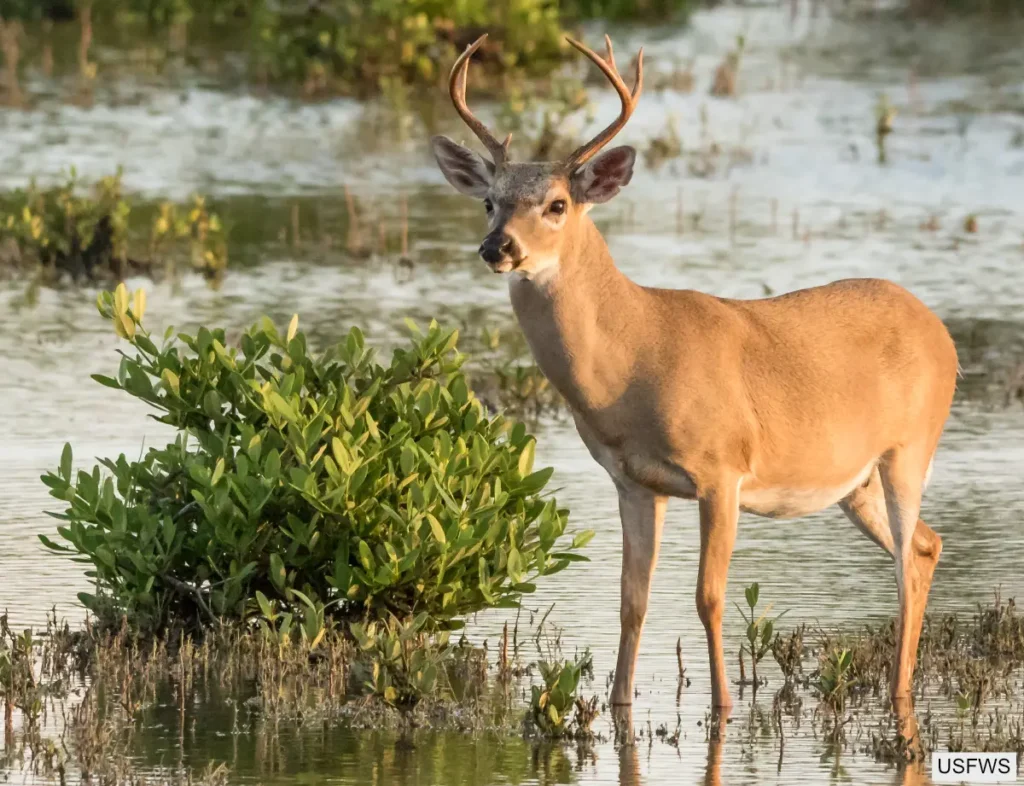
- Scientific name: Odocoileus virginianus clavium
- Family: Cervidae
- Rank: Subspecies
The Florida Key Deer is a small subspecies of white-tailed deer known for its diminutive size, standing about 30 inches tall at the shoulder and weighing 60 to 75 pounds. It has a reddish-brown coat in summer that fades to grayish-brown in winter, with a white underside and characteristic white tail underside. Males have small, slender antlers with few points.
This subspecies is found only in the Florida Keys, where it inhabits pine rocklands, hardwood hammocks, and mangrove forests. It is most often seen near roads or residential areas on the islands where it forages on shrubs, grasses, and fruits.
The Florida Key Deer is regionally notable as an endangered subspecies unique to this isolated chain of islands, making its conservation critical for preserving Florida’s native wildlife diversity.
Florida Mouse
(No photo available)
- Scientific name: Podomys floridanus
- Family: Cricetidae
- Rank: Species
The Florida mouse is a small rodent measuring about 5 to 7 inches in total length, including a long tail roughly equal to its body length. It has a slender body with soft, grayish-brown fur on top and a lighter, whitish underside. Its large, rounded ears and dark eyes stand out, helping to distinguish it from other local rodents. The tail is often slightly darker on top and covered with short hairs.
This species lives primarily in sandy upland habitats such as pine flatwoods and scrub areas in central and southern Florida. It is nocturnal and typically found in burrows beneath palmetto plants or other dense ground cover. The Florida mouse is endemic to Florida, meaning it is found nowhere else, and it plays an important role in the ecology of the dry habitats in which it lives.
Florida Panther
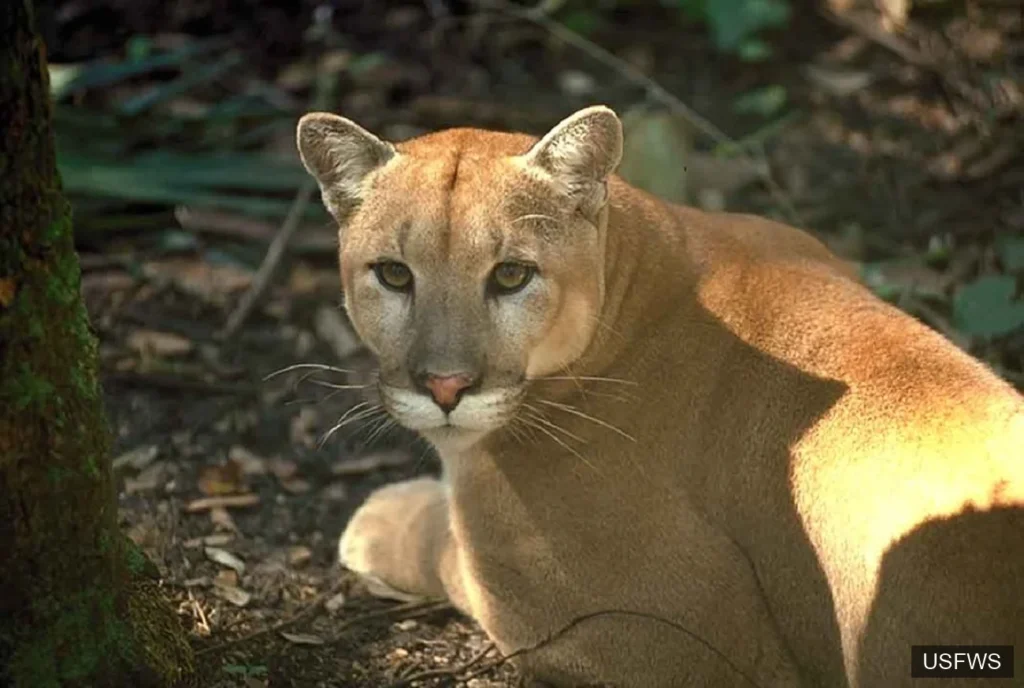
- Scientific name: Puma concolor couguar / Puma concolor coryi
- Family: Felidae
- Rank: Subspecies (see text)
Despite bbeing rarely-seen, the Florida panther is one of Florida’s most iconic mammals. Previously categorised as a separate subspecies of mountain lion, it has now been combined with another mountain lion subspecies, the North American cougar (Puma concolor couguar). (The name “Florida panther” now refers to members of the North American cougar subspecies found in Florida.)
The Florida panther has a tawny to reddish-brown coat with a lighter, creamy underside. Its body is sleek and muscular, measuring about 6 to 8 feet in length from head to tail tip, with adult males generally larger than females. The rounded ears and long tail, which often ends with a black tip, help distinguish it from other large cats.
This subspecies of cougar inhabits hardwood forests, swamps, and pinelands primarily in southern Florida. It is most often encountered in remote, dense vegetation where it hunts deer, wild hogs, and smaller mammals. The Florida Panther is regionally notable as the only breeding cougar population east of the Mississippi River and is an important symbol of Florida’s wildlife conservation efforts.
Key Largo Woodrat
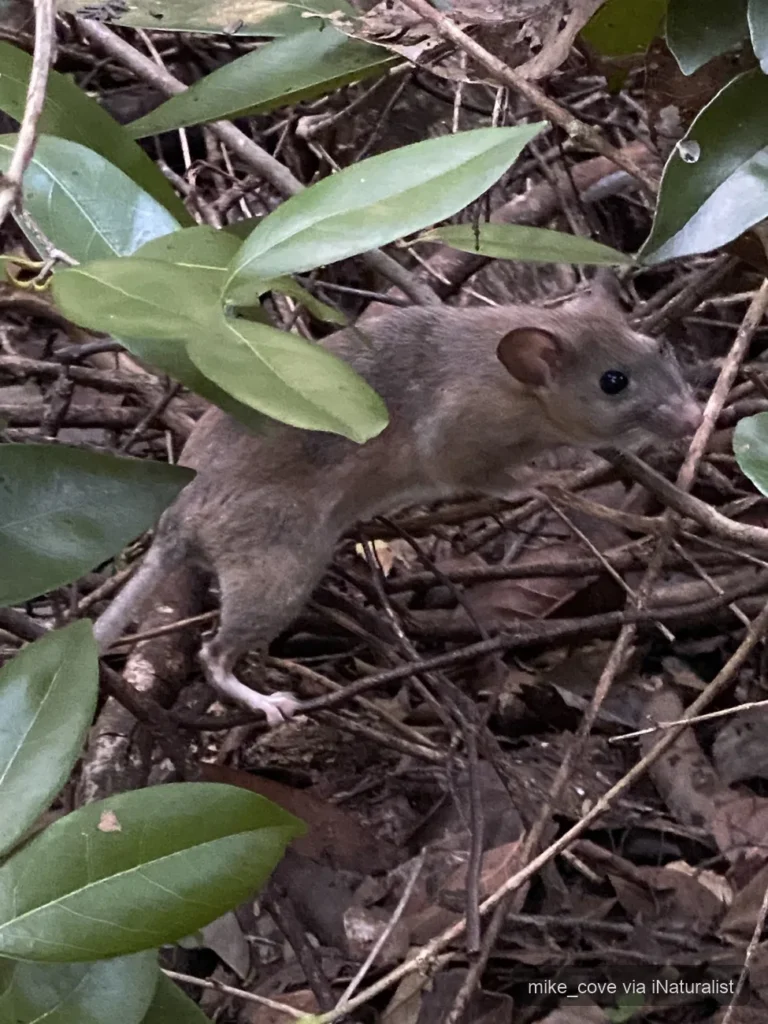
- Scientific name: Neotoma floridana smalli
- Family: Cricetidae
- Rank: Subspecies
The Key Largo Woodrat is found exclusively in the tropical hardwood forests of Key Largo, Florida. It prefers dense, undisturbed habitats with abundant leaf litter and woody debris, where it builds large stick nests. This subspecies is typically encountered at night or during twilight hours.
This woodrat measures about 10 to 14 inches in total length, including a bushy tail nearly equal to its body length. Its fur is grayish-brown on the back with a lighter, creamy underside. The large eyes and ears are distinctive, aiding in identification. Compared to other woodrats, it is slightly smaller and has a more compact build.
Regionally notable for its limited range, the Key Largo Woodrat is an important species for conservation, as it is endemic to the Florida Keys and sensitive to habitat loss.
Marsh Rabbit
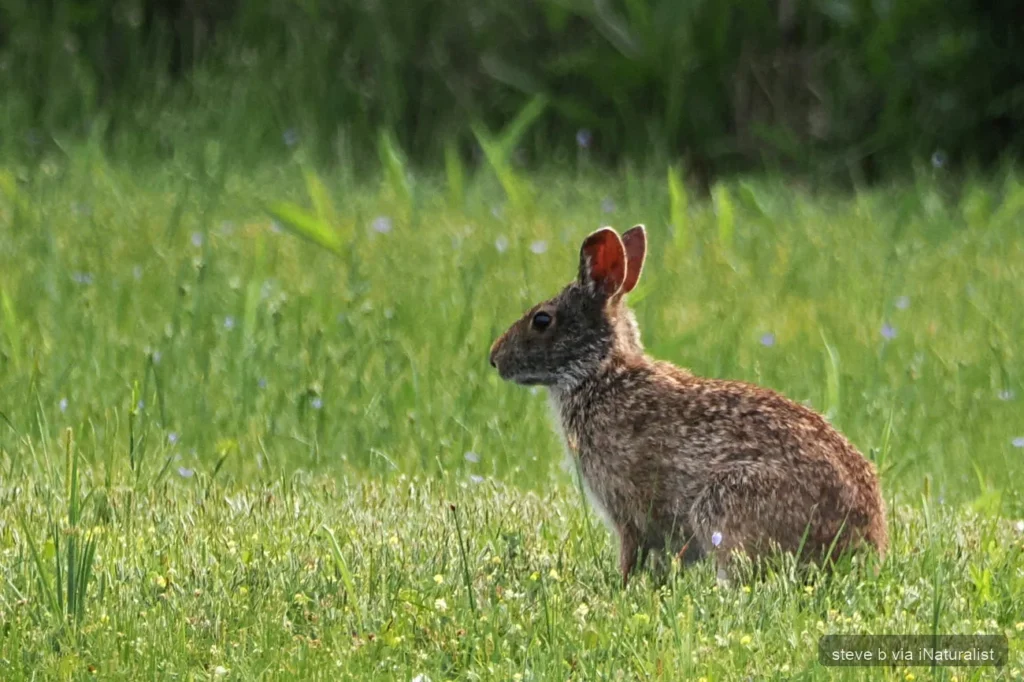
- Scientific name: Sylvilagus palustris
- Family: Leporidae
- Rank: Species
The marsh rabbit is a small, compact mammal with dark gray to blackish fur and a notably short, almost hidden tail that appears as a small white spot from behind. Adults typically measure about 16 to 20 inches in length and weigh around 2 to 4 pounds. Its rounded ears are smaller than those of other rabbits, and its legs are shorter, adaptations suited for moving through dense marsh vegetation.
This species is commonly found in wetland habitats such as freshwater and brackish marshes, swamps, and coastal mangroves throughout Florida. It is often seen near water, where it feeds on grasses, aquatic plants, and other vegetation. The marsh rabbit is regionally notable for its specialization in these wet environments, distinguishing it from the more widespread eastern cottontail.
Mexican Free-Tailed Bat / Brazilian Free-Tailed Bat
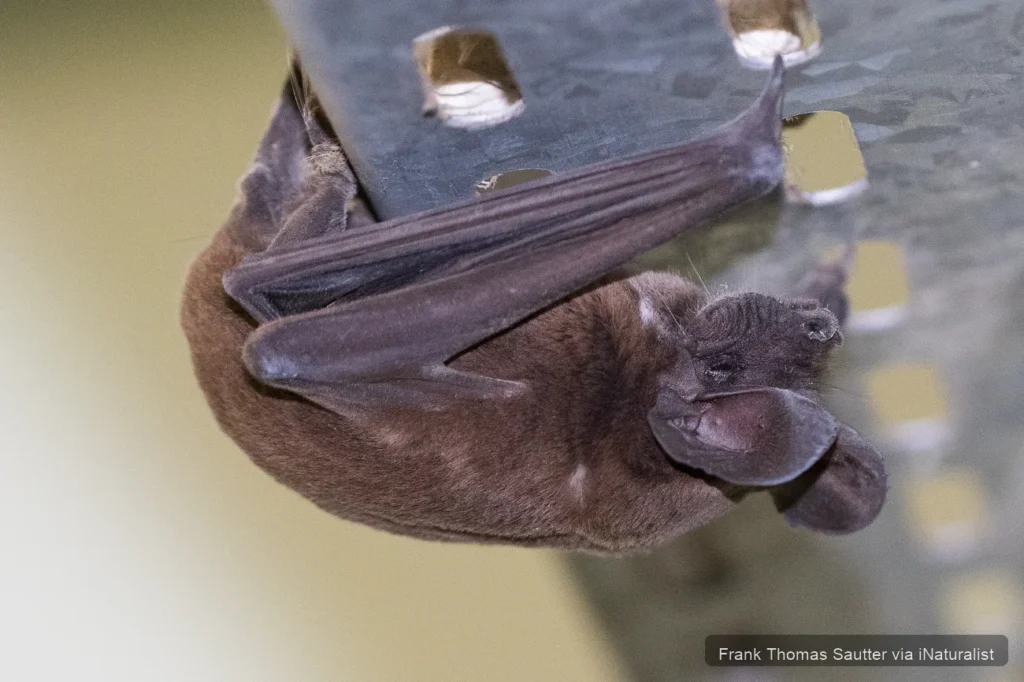
- Scientific name: Tadarida brasiliensis
- Family: Molossidae (free-tailed bats)
- Rank: Species
The Mexican free-tailed bat (also known as the Brazilian free-tailed bat) is one of the most widespread and recognizable bats in Florida. This medium-sized bat has dark brown to gray fur, long narrow wings, and a tail that extends noticeably beyond the membrane between its legs — giving it the “free-tailed” name.
It is a fast and agile flier, capable of covering long distances while hunting insects at night. Brazilian free-tailed bats are highly beneficial to humans because they consume enormous numbers of mosquitoes, moths, beetles, and agricultural pests.
Mexican free-tailed bat bats are very social and often gather in large colonies that can number in the thousands or even millions. During the day, they roost in bridges, caves, stadiums, abandoned buildings, and other sheltered structures. Around sunset, groups emerge dramatically into the evening sky to feed.
In Florida, Brazilian free-tailed bats can be seen throughout much of the state, especially in urban and suburban areas where bridges and buildings provide ideal roosting sites. Some well-known viewing locations include:
- University of Florida Bat Houses — home to one of the world’s largest occupied bat house colonies.
- Bridges and overpasses in cities such as Tampa, Orlando, and Miami often shelter colonies.
The best time to observe them is at dusk during warm months, when they leave their roosts in swirling groups to hunt insects in the night sky.
Nine-banded Armadillo
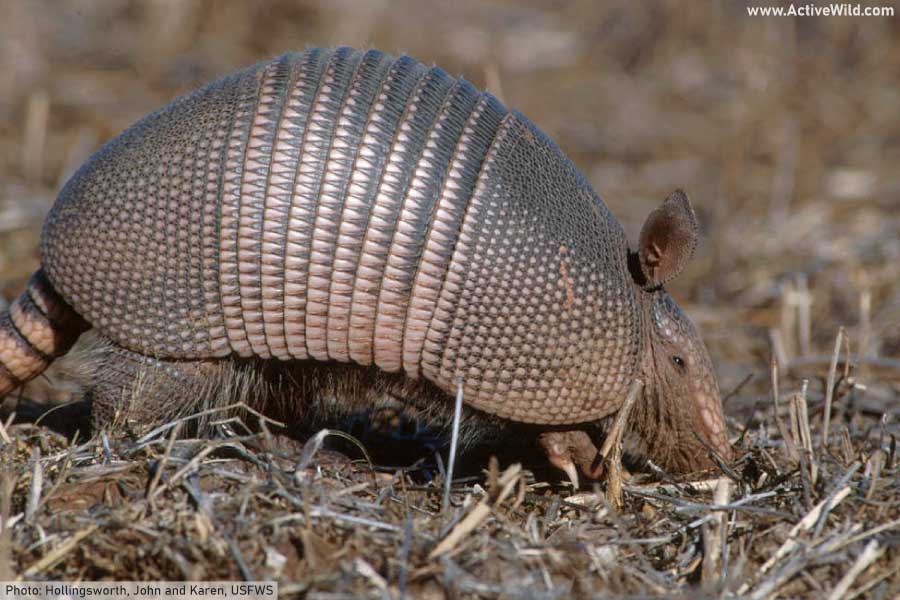
- Scientific name: Dasypus novemcinctus
- Family: Dasypodidae
- Rank: Species
The nine-banded armadillo is a medium-sized mammal with a distinctive armored shell covering its back, head, and tail. Adults typically measure about 15 to 17 inches long, excluding the tail, which can add another 14 to 16 inches. The body is low and broad, with short legs and a long, pointed snout. Its armor consists of overlapping bony plates separated by flexible bands, usually nine in number, which aid in identifying the species.
This armadillo is commonly found in a variety of habitats across Florida, including forests, grasslands, and suburban areas, often near water sources. It is primarily nocturnal and known for digging burrows and rooting through leaf litter for insects and other small invertebrates.
Southeastern Pocket Gopher
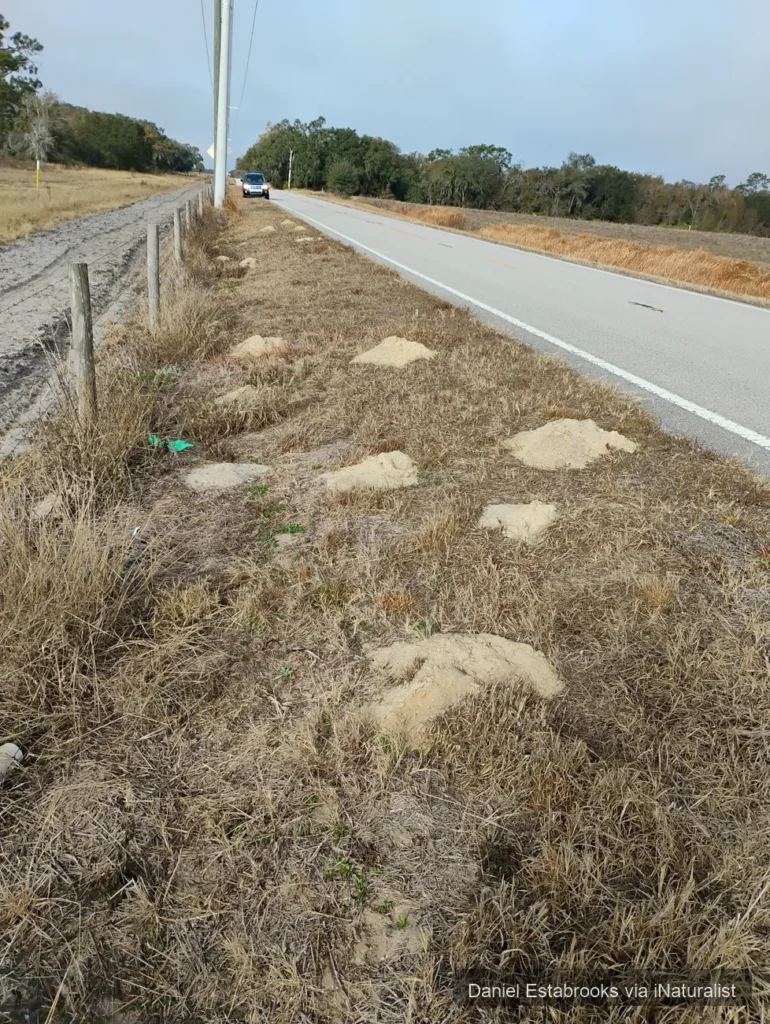
- Scientific name: Geomys pinetis
- Family: Geomyidae
- Rank: Species
The Southeastern Pocket Gopher has a compact body covered with soft fur that ranges from yellowish-brown to reddish-brown on top, with lighter, often whitish underparts. It has small eyes and ears, a blunt nose, and strong front feet equipped with long claws for digging. Adults typically measure about 7 to 10 inches in length, including a short tail, and weigh roughly 5 to 10 ounces. Their cylindrical shape and fur-lined cheek pouches are key identification features.
This species is commonly found in sandy soils throughout Florida’s pine forests, scrublands, and open grassy areas, where it creates extensive underground burrow systems. Southeastern Pocket Gophers are rarely seen above ground but leave characteristic mounds of soil at their burrow entrances. They are regionally notable for their role in soil aeration and ecosystem engineering, influencing plant community dynamics in Florida’s upland habitats.
Southern Flying Squirrel

- Scientific name: Glaucomys volans
- Family: Sciuridae (the squirrel family)
- Rank: Species
The Southern flying squirrel is a small nocturnal rodent known for its large dark eyes and remarkable gliding ability. Using a flap of skin (called a patagium) stretched between its front and back legs, it can glide silently between trees while searching for food such as nuts, seeds, fruits, fungi, and insects.
Southern flying squirrels are common throughout Florida but are rarely seen because they are active only at night. They inhabit hardwood forests, pine woodlands, suburban neighborhoods, parks, and wooded hammocks. In Florida, they typically nest in tree cavities, abandoned woodpecker holes, nest boxes, and occasionally attics or other sheltered structures.
West Indian Manatee
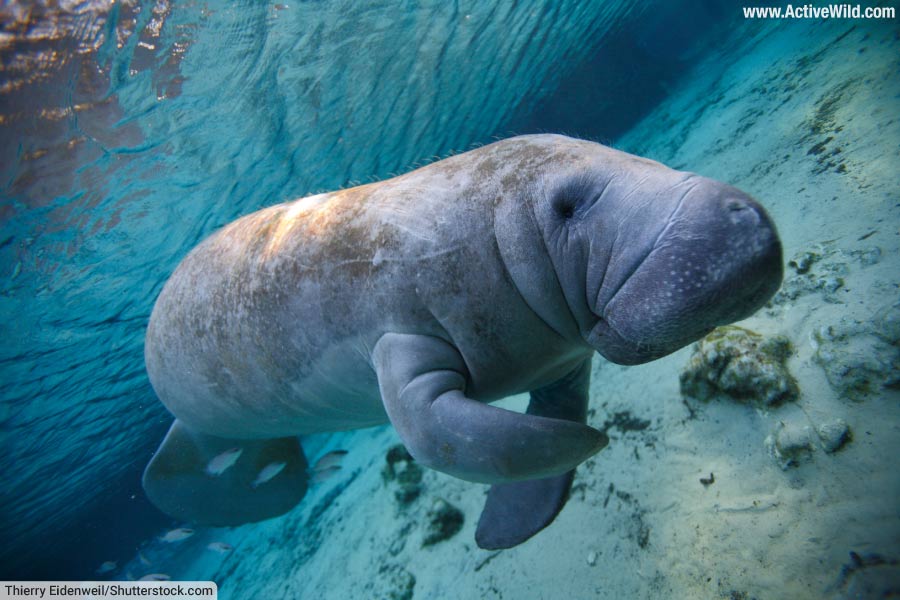
- Scientific name: Trichechus manatus
- Family: Trichechidae
- Rank: Species
One of Florida’s best-known mammals is the manatee. The Florida manatee (which is also found in nearby regions of the southeastern United States and the Caribbean) is a subspecies of the West Indian Manatee.
Manatees inhabit warm coastal waters, rivers, and estuaries in Florida, often seen near seagrass beds where they feed. These large, slow-moving mammals have a robust, paddle-shaped body covered with thick, wrinkled gray skin, sometimes marked with algae or scars. Adults typically measure 9 to 13 feet long and weigh between 800 and 1,200 pounds.
Their broad, flat tails and rounded snouts with stiff whiskers help distinguish them from other aquatic mammals. They have two forelimbs shaped like flippers, which they use for steering, but no hind limbs. Males and females look similar, making sex identification difficult without close examination. Manatees surface regularly to breathe, often visible near warm water sources in winter.
This species is regionally notable in Florida as a protected marine mammal and a key indicator of healthy coastal ecosystems, attracting conservation efforts due to its vulnerability to habitat loss and boat collisions.
Further Reading
You can find out more about the wildlife of Florida on the following pages:
- Florida Wildlife – The Ultimate Guide
- Birds in Florida
- Snakes in Florida
- Lizards in Florida
- Spiders in Florida
- Scorpions in Florida
Discover more about mammals on these pages: