
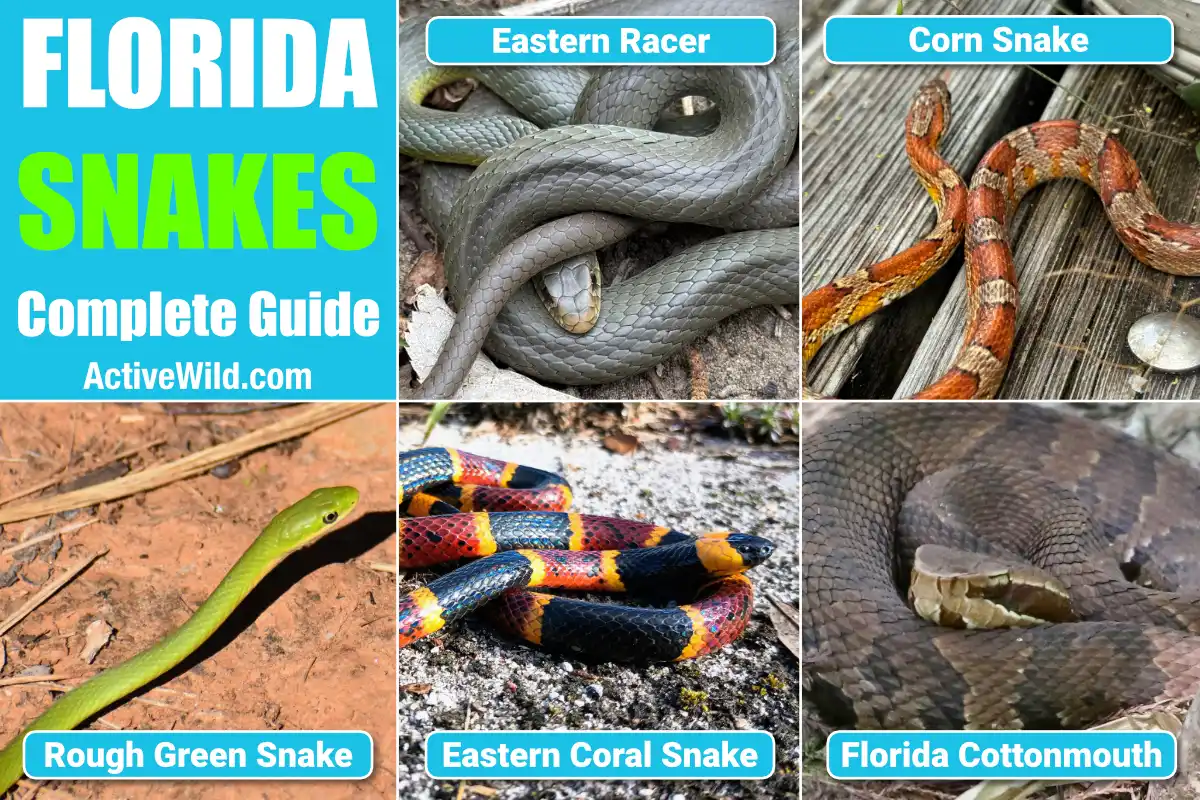
A list of Florida snakes with pictures and ID guides. Discover venomous and non-venomous snake species found in Florida.
Page Index
Introduction
Florida’s diverse range of snake species contribute significantly to the state’s ecosystems, both as predators and prey. From the vividly-colored (and venomous) Eastern Coral Snake to the secretive Mud Snake, these reptiles exhibit considerable variation in appearance, behavior, and habitat.
For residents and nature enthusiasts, recognizing common snakes across Florida can deepen appreciation and enhance safety. This article introduces a selection of notable species, providing insights into their natural history and identification. While not comprehensive, the list contains representative snakes that illustrate Florida’s rich herpetological diversity.
Florida Venomous Snakes
Venomous snakes found in Florida include the eastern diamondback rattlesnake, dusky pigmy rattlesnake, Florida cottonmouth and eastern coral snake (details of these species can be found in the Florida Snakes list below).
Although contact with any snake should be avoided, particular care should be taken with these species, whose bites are potentially life-threatening.
Banded Water Snake
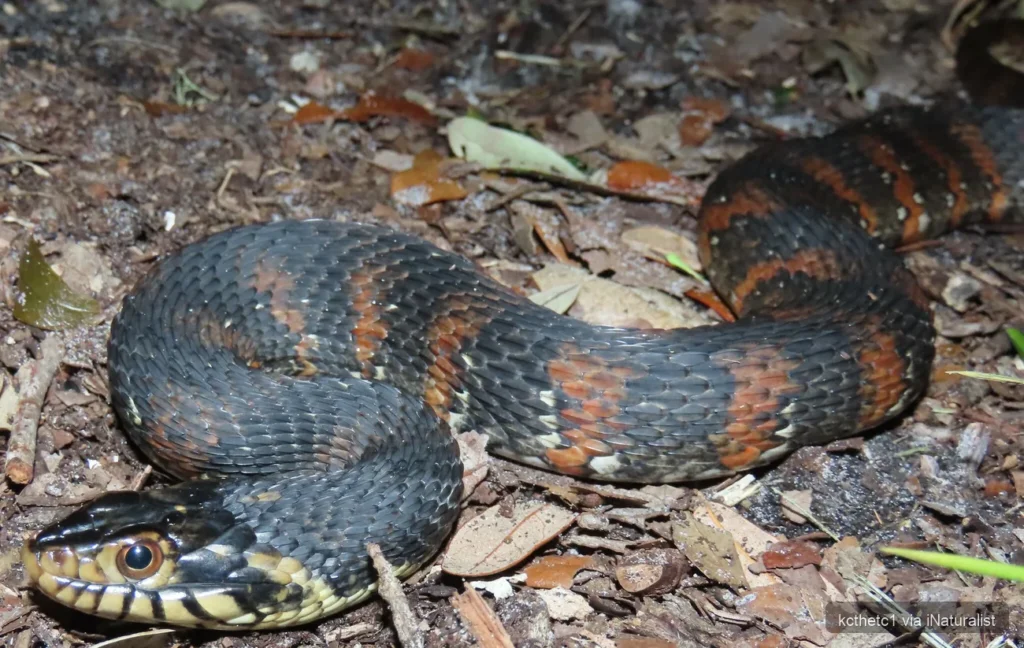
- Scientific name: Nerodia fasciata
- Family: Colubridae
This species features a stout body adorned with dark crossbands on a lighter background, which become more pronounced toward the tail. Its keeled scales give it a rough texture, and the belly is typically lighter with dark crescent-shaped markings. Adults usually range from 24 to 42 inches (61 to 107 cm) in length.
Commonly found in freshwater habitats such as ponds, lakes, and slow-moving streams throughout Florida, the snake is nonvenomous and often observed basking near water or swimming. Like other water snakes, when threatened, it flattens its body and releases a musky odor as a defense.
Brown Water Snake
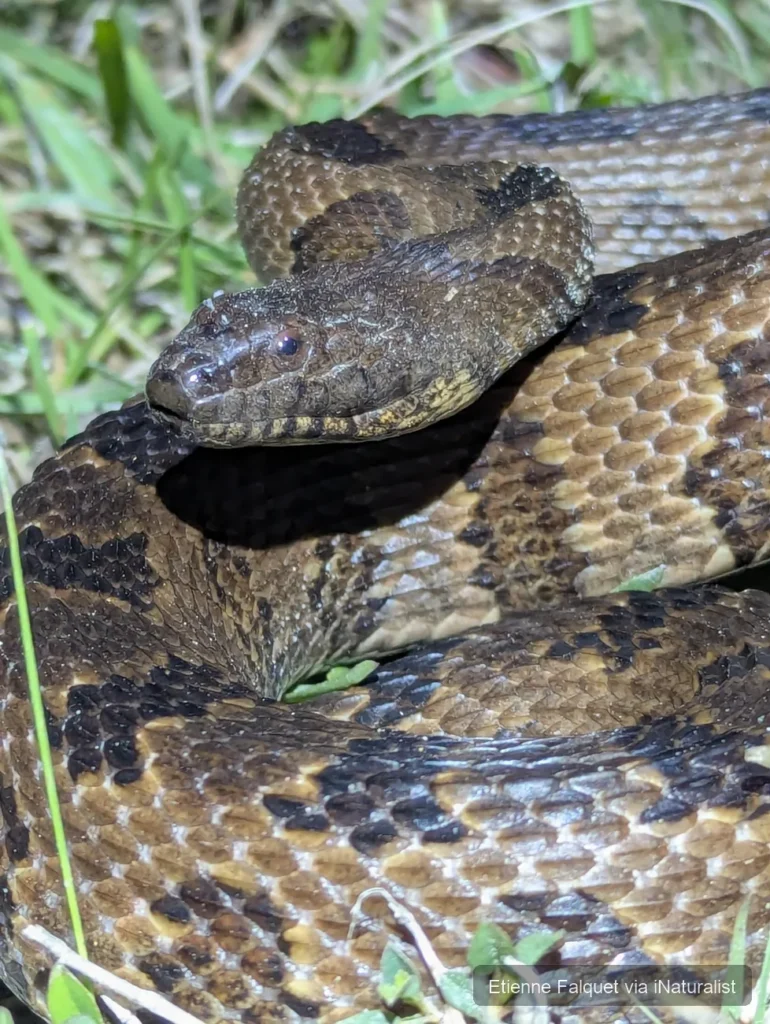
- Scientific name: Nerodia taxispilota
- Family: Colubridae
This snake displays a brown or reddish-brown body with darker blotches arranged irregularly along its length. Its keeled scales provide a rough texture, and the belly is lighter with dark crescent-shaped markings. Adults typically measure 24 to 42 inches (61 to 107 cm) and have a stout build that sets them apart from slender species.
Found in freshwater environments like swamps, rivers, and lakes statewide, it is nonvenomous and often seen swimming or resting near water. When threatened, it may flatten its head and body and, like the related banded water snake, emit a musky scent as a defense.
Coachwhip

- Scientific name: Masticophis flagellum
- Family: Colubridae
The coachwhip has a long, slender body with smooth scales varying from tan to pinkish or light brown, often appearing faded or uniform. The head is slightly wider than the neck and blends smoothly into the body without a distinct neck. Its notably long, whip-like tail can constitute about one-third of its total length. Adults typically measure 50 to 70 inches (127 to 178 cm), making it one of Florida’s larger snakes.
It inhabits dry, open areas such as sandhills, pine flatwoods, and scrub, moving quickly on the ground and occasionally climbing low shrubs. Active during the day, it is known for speed and alertness while hunting small mammals, birds, and lizards using keen eyesight. When threatened, it prefers escape over confrontation.
A key feature is its long, slender tail, sometimes darker and resembling a braided whip, which inspires its name. Males and females appear similar, though females tend to be slightly larger. This nonvenomous snake relies on agility and speed to avoid predators and catch prey.
In Florida, it is generally the eastern coachwhip subspecies that is found.
Common Ribbon Snake
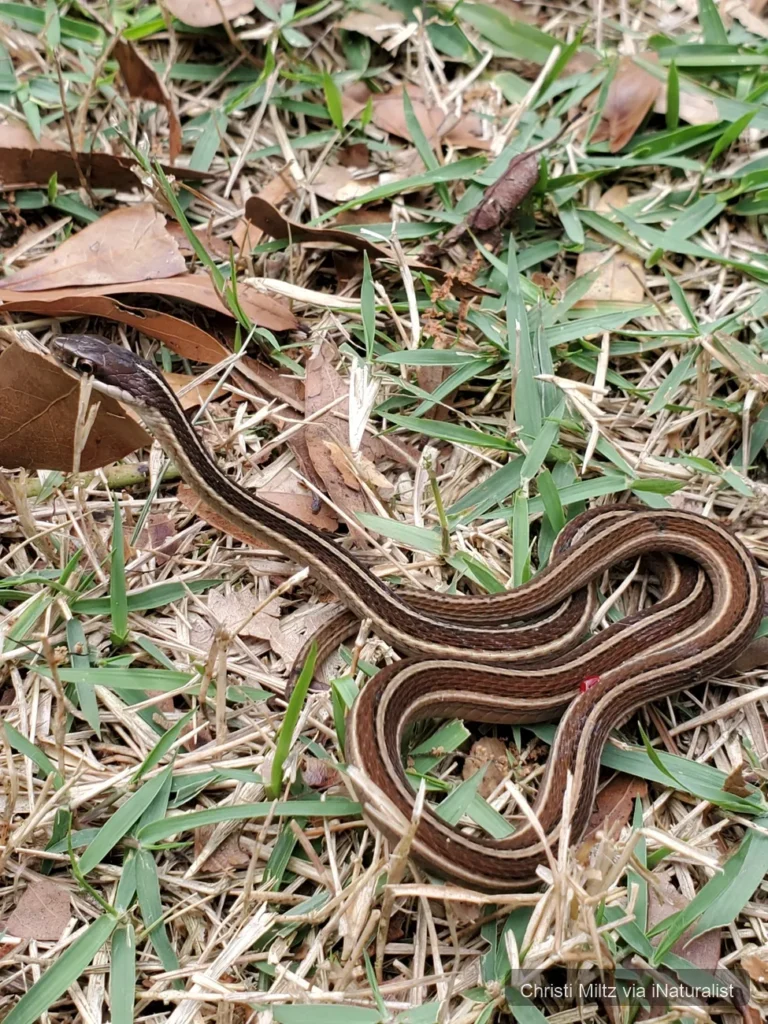
- Scientific name: Thamnophis saurita
- Family: Colubridae
This slender snake has a dark, nearly black body with three bright yellow stripes running lengthwise from head to tail. These narrow, well-defined stripes include one along the center of the back and one on each side. The belly is pale yellow or white, and smooth scales give it a sleek look. Adults measure between 18 and 32 inches (81 cm), noticeably slender compared to many local snakes.
Often found near water sources such as ponds, marshes, and slow streams, it moves quickly through grassy or brushy areas. Nonvenomous, it frequently hunts small amphibians and fish. When approached, it tends to flee swiftly into vegetation or water, relying on agility to escape.
Corn Snake
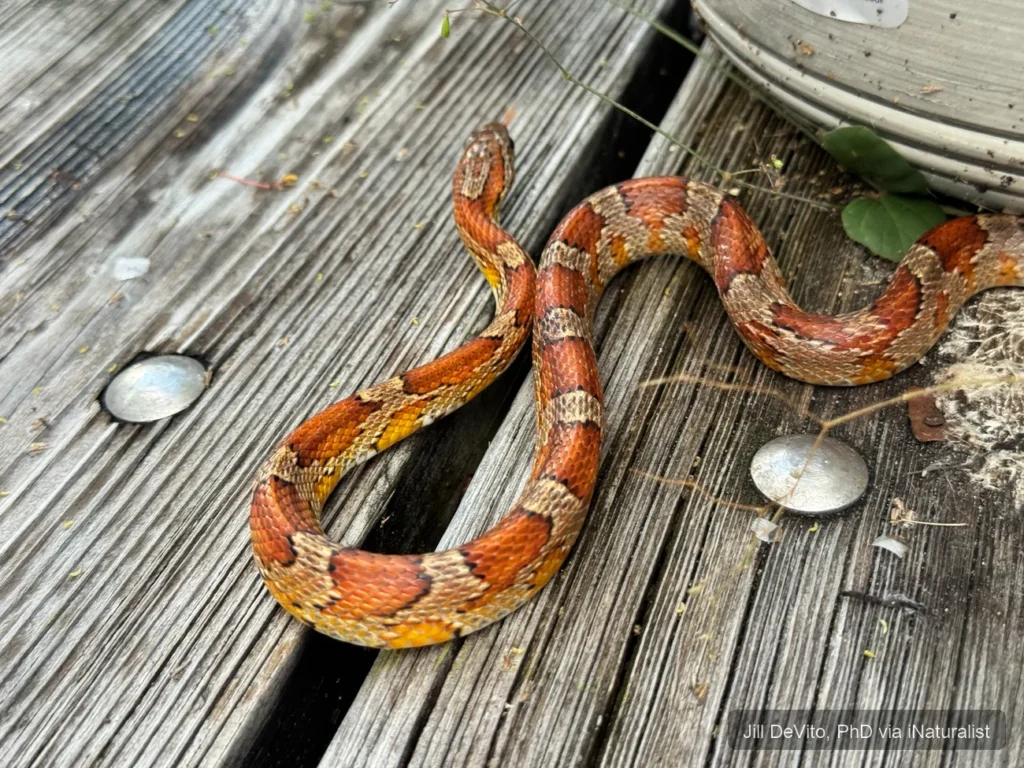
- Scientific name: Pantherophis guttatus
- Family: Colubridae
This medium-sized snake ranges from 24 to 72 inches (61 to 183 cm) in length, with a slender, muscular body. Its smooth scales bear reddish-orange blotches bordered in black, arranged on a lighter tan to orange background. The belly features a distinctive black and white checkerboard pattern, aiding differentiation from other Florida snakes.
It moves on the ground and climbs low vegetation or structures, inhabiting forests, fields, and suburban areas where it preys on small rodents, birds, and reptiles. The head is slightly wider than the neck, and the eyes have round pupils.
The blotch pattern and checkerboard belly, along with generally calm behavior when handled, contribute to its popularity in the pet trade. This nonvenomous species subdues prey by constriction.
Eastern Coral Snake
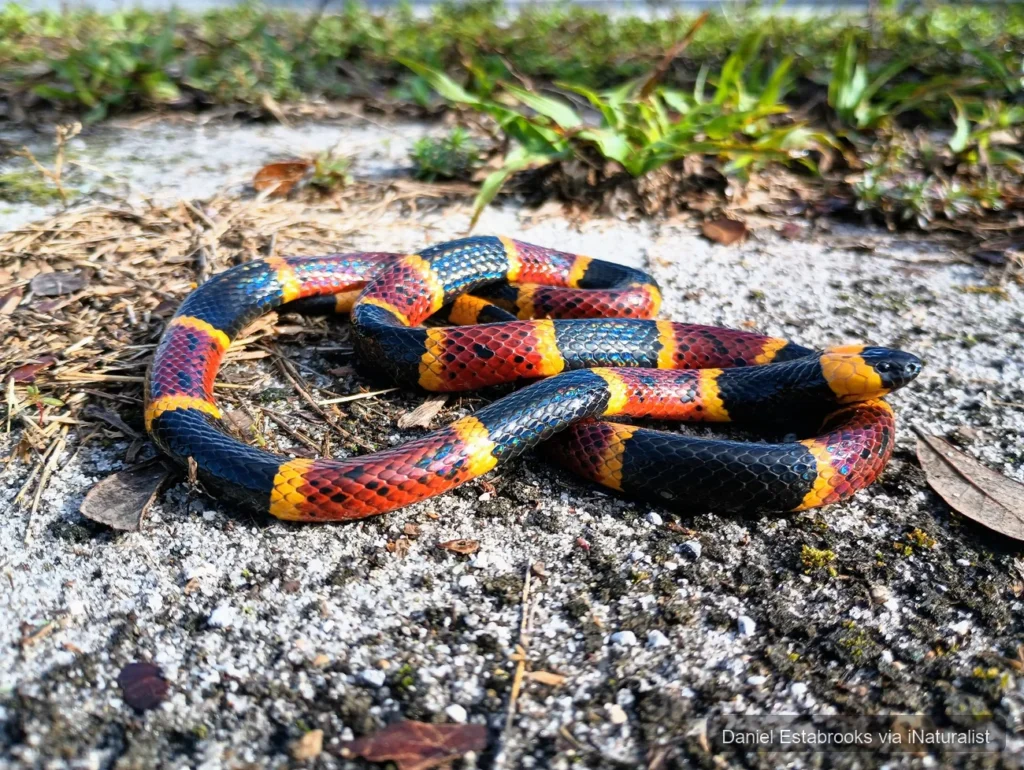
- Scientific name: Micrurus fulvius
- Family: Elapidae
This brightly colored snake inhabits wooded areas, pine flatwoods, and wetlands in the southeastern U.S., including Florida. It has a slender body measuring 20 to 30 inches (51 to 76 cm) long. Its most distinctive feature is the banded pattern of red, yellow, and black rings, with red bands touching yellow ones, distinguishing it from nonvenomous mimics.
The small head blends smoothly into the neck without noticeable widening. It spends much time underground or hidden beneath leaf litter and logs but may surface during warm months. Venomous with potent neurotoxic venom, bites to humans are rare due to its reclusive nature and small mouth.
A helpful identification rhyme is “Red touch yellow, kill a fellow; red touch black, friend of Jack,” which reliably differentiates it from harmless mimics.
Eastern Diamondback Rattlesnake
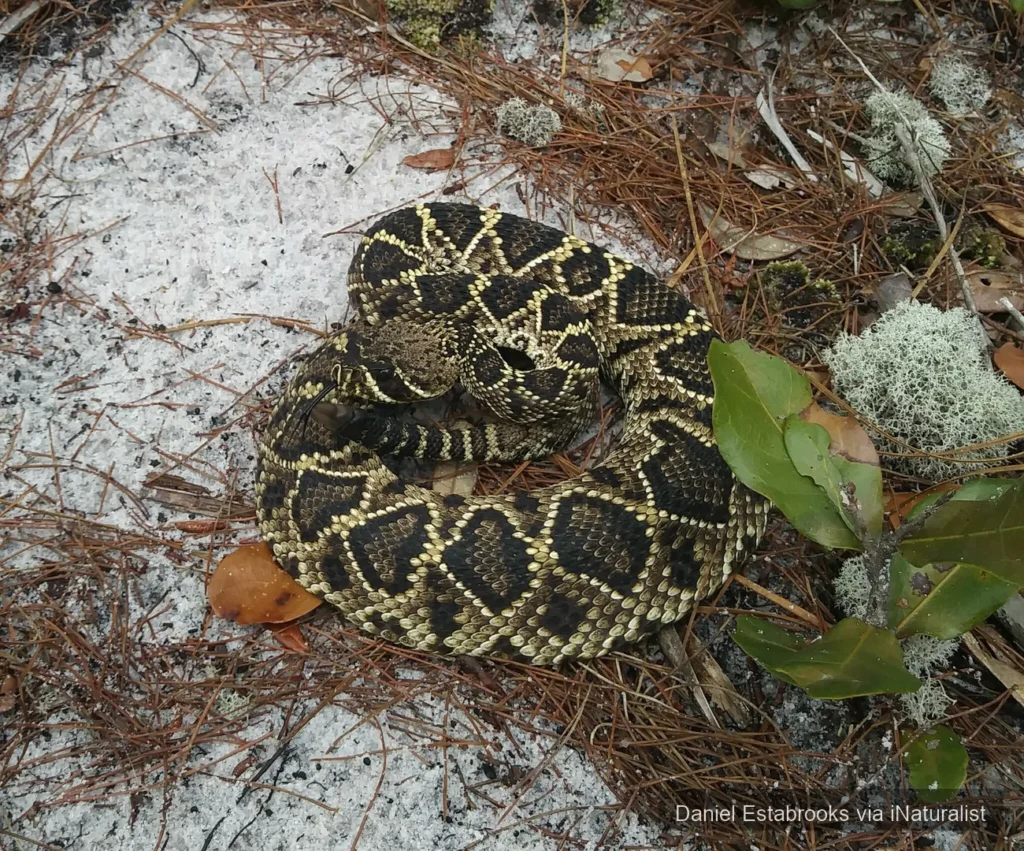
- Scientific name: Crotalus adamanteus
- Family: Viperidae
This rattlesnake features a thick, heavy body marked by dark diamond-shaped patterns outlined in lighter scales along its back. Its coloration varies from yellowish-brown to gray with a lighter belly. The rattle at the tail’s end produces a buzzing sound when vibrated. Adults often measure 48 to 72 inches (122 to 183 cm), making it Florida’s largest rattlesnake.
Typically found on the ground in dry habitats like pine forests, sandhills, and coastal scrub, it is primarily active during warmer parts of the day. Heat-sensing pits help detect prey such as small mammals and birds. Males and females share similar markings and sizes, though males may occasionally be longer.
This species possesses potent venom used to immobilize prey and defend itself but generally avoids confrontation by retreating when possible.
Dusky Pygmy Rattlesnake
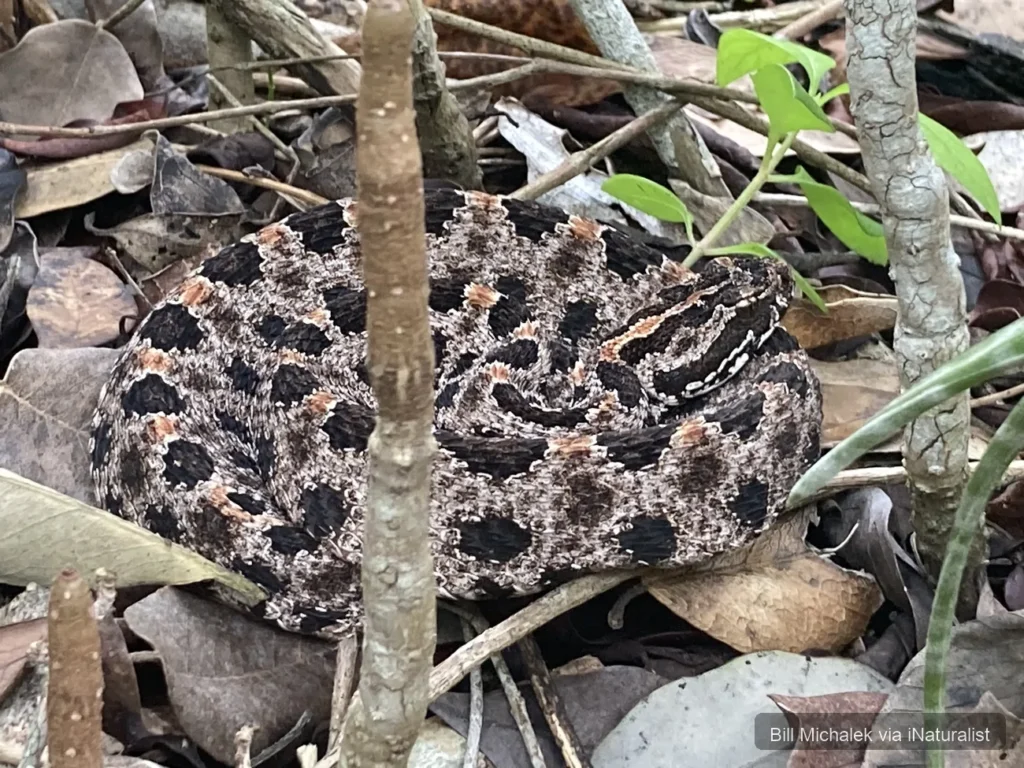
- Scientific name: Sistrurus miliarius barbouri
- Family: Viperidae
This small rattlesnake has a thick body with a gray to light brown background color covered in dark blotches running along the back and sides. Many individuals display a faint reddish-brown stripe extending down the center of the back. Keeled scales give the snake a rough texture, and the tail ends in a tiny rattle that produces a faint buzzing sound. Adults typically measure 12 to 24 inches (30 to 61 cm), making it one of Florida’s smallest venomous snakes.
It inhabits a variety of environments including pine flatwoods, marsh edges, scrublands, and areas near freshwater wetlands. Often remaining motionless to avoid detection, it relies heavily on camouflage and may be difficult to spot among leaf litter or low vegetation. It feeds mainly on small frogs, lizards, rodents, and insects.
Although venomous, this species is generally not aggressive and usually depends on concealment rather than confrontation when disturbed. Its compact size, dark blotches, reddish dorsal stripe, and tiny rattle help distinguish it from larger rattlesnakes found in Florida.
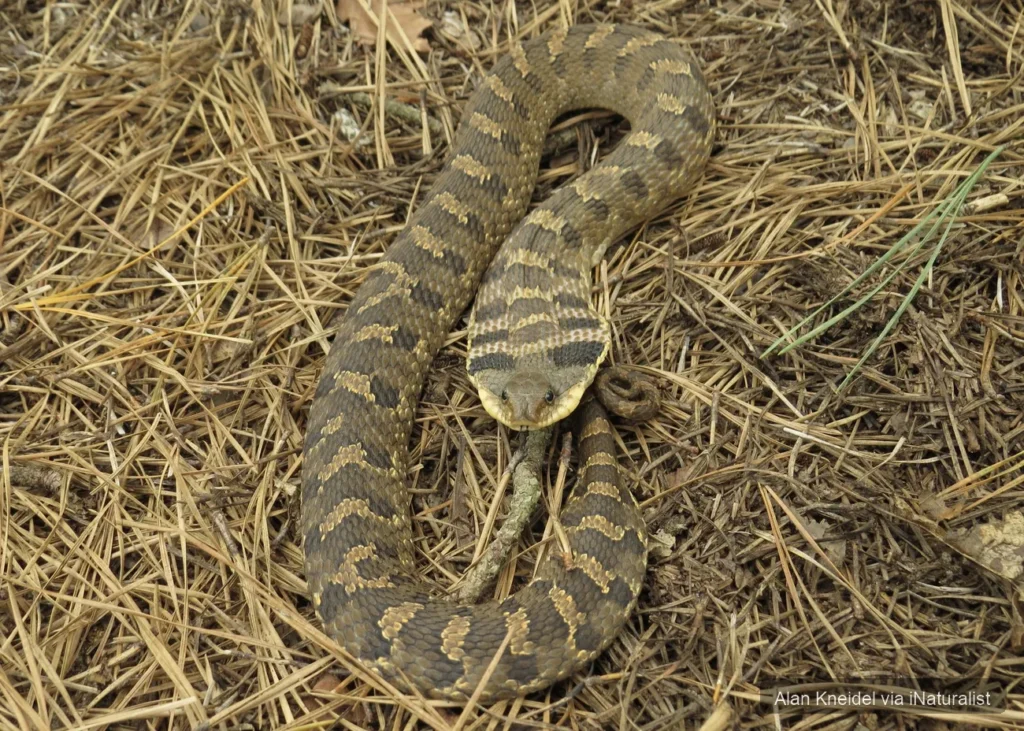
Eastern Hognose Snake
- Scientific name: Heterodon platirhinos
- Family: Colubridae
This relatively stout snake has a broad, upturned snout giving its head a pig-like profile. Adults measure 20 to 35 inches (51 to 89 cm). Body coloration varies from tan to gray or reddish, often with dark blotches or spots along the back and sides, distinguishing it from other regional snakes.
It inhabits sandy or loose soil environments such as pine flatwoods, open woodlands, and wetland edges, often buried or concealed under leaves. Known for defensive displays, it may flatten its neck and body, hiss loudly, or play dead to deter predators.
Common in Florida areas with ample ground cover and loose substrate, males and females look alike. Its unique snout and bluffing behaviors aid identification.
Eastern Indigo Snake

- Scientific name: Drymarchon couperi
- Family: Colubridae
This snake exhibits a glossy, iridescent black-blue body with smooth scales creating a sleek appearance. It has a long, slender shape with a relatively small head distinct from the neck. Adults typically measure 5 to 7 feet (1.5 to 2.1 m), making it the longest nonvenomous snake in the region. The belly is lighter, often pale cream or orange, contrasting with the dark upper body.
Mostly found in upland habitats like pine flatwoods, sandhills, and dry scrub, it moves actively on the ground. Nonvenomous, it preys on various animals including other snakes, lizards, frogs, and small mammals. Males and females appear similar, though males sometimes grow longer. Its large size and shiny black coloration distinguish it from other Florida snakes.
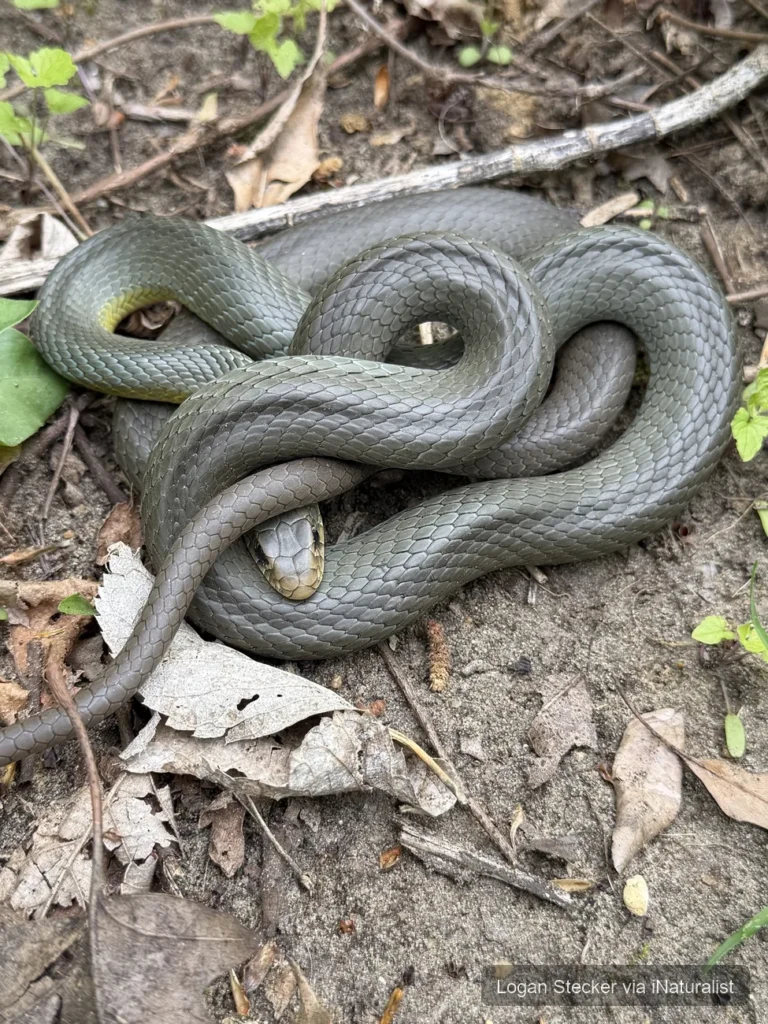
Eastern Racer (North American Racer)
- Scientific name: Coluber constrictor
- Family: Colubridae
This slender snake grows between 24 and 72 inches (183 cm) long and has smooth, shiny scales that create a sleek appearance. Its coloration is predominantly uniform black with a slightly lighter underside, distinguishing it from patterned or keeled species. The narrow head is not much wider than the neck, contributing to its streamlined form.
It frequents open, dry areas such as fields, roadsides, and forest edges, moving quickly and actively during daylight. Nonvenomous, it relies on speed to evade threats rather than defensive aggression. Its diet mainly includes insects, frogs, and other reptiles.
The southern black racer subspecies (Coluber constrictor priapus) is one of the most commonly-seen snakes in Florida.
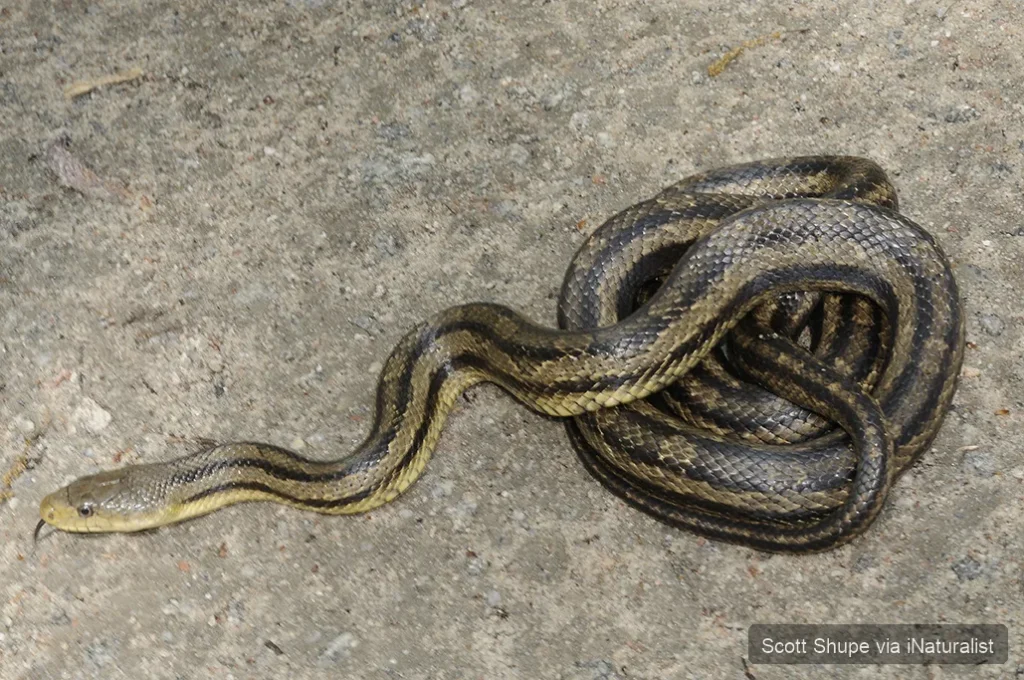
Eastern Ratsnake
- Scientific name: Pantherophis alleghaniensis
- Family: Colubridae
This snake is frequently seen in wooded areas, suburban neighborhoods, and near agricultural fields across Florida. It has a slender, muscular body with smooth scales, typically gray or light brown with darker blotches or saddles that fade with age. The pale belly displays a checkered pattern. The head is slightly wider than the neck, featuring large, round eyes with round pupils.
Adults usually measure 3 to 5 feet (0.9 to 1.5 m), with no significant size difference between sexes. Nonvenomous, it moves adeptly on the ground and in trees, hunting rodents, birds, and eggs. Its climbing ability and blotched pattern help distinguish it locally.
Common in various habitats including forests, wetland edges, and human-altered areas, it is generally active during day and evening. When threatened, it may vibrate its tail in leaf litter as a warning but typically avoids confrontation.
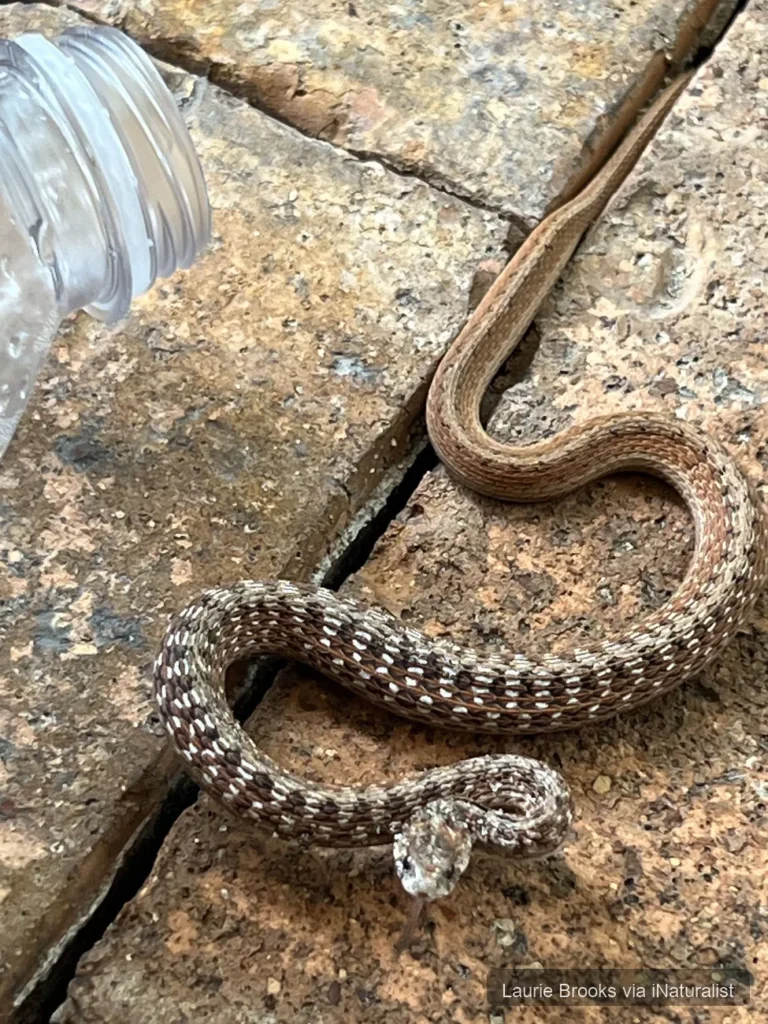
Florida Brown Snake
- Scientific name: Storeria dekayi victa
- Family: Colubridae
This small snake has a slender body measuring 7 to 14 inches (18 to 36 cm). Coloration ranges from light brown to grayish, often with a subtle darker stripe down the center of the back and faint, irregular side blotches. Smooth scales and a slightly wider head with large, round eyes give it a gentle appearance.
Common in urban and suburban settings like gardens, parks, and leaf litter areas, it hides under debris, logs, or rocks and may be seen after rain or in warm weather. Its small size and secretive habits mean it is usually noticed only when moving slowly or briefly exposed while hunting small invertebrates.
Nonvenomous and harmless to humans, it primarily feeds on earthworms, slugs, and soft-bodied insects. Its modest size and muted colors help it blend into leaf litter, making it less conspicuous than many other Florida snakes.
Florida Cottonmouth
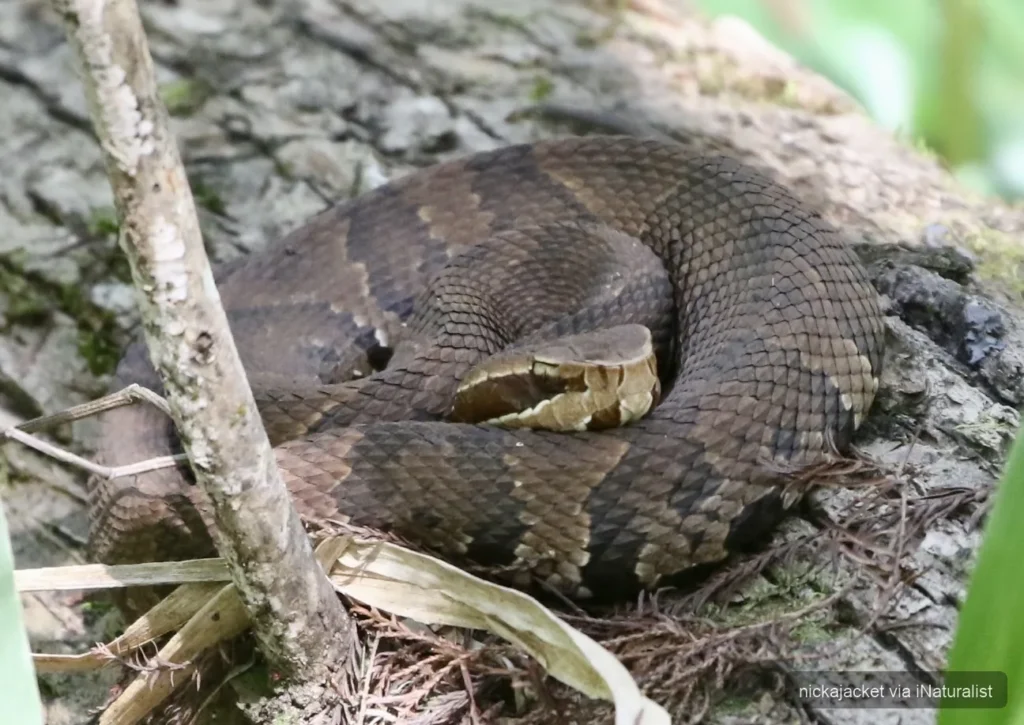
- Scientific name: Agkistrodon conanti
- Family: Viperidae
This venomous snake has a thick, heavy body typically 24 to 48 inches (61 to 122 cm) long. Its broad, triangular head is noticeably wider than the neck, with vertical elliptical pupils. Coloration usually includes dark brown or olive tones with darker crossbands, which may fade in adults. A key feature is the white interior of its mouth, displayed when threatened.
Primarily found in freshwater wetlands such as swamps, marshes, and along lakes and rivers, it is semi-aquatic and comfortable in water or on land, often basking near or moving through water. Dense vegetation and slow-moving or still water are typical encounter sites.
Adults generally weigh 1 to 3 pounds (0.5 to 1.4 kg). Defensive behavior includes opening the mouth wide to reveal the white interior as a warning. Its venom is hemotoxic, affecting blood and tissue, and medical attention is necessary if bitten.
Florida Green Watersnake
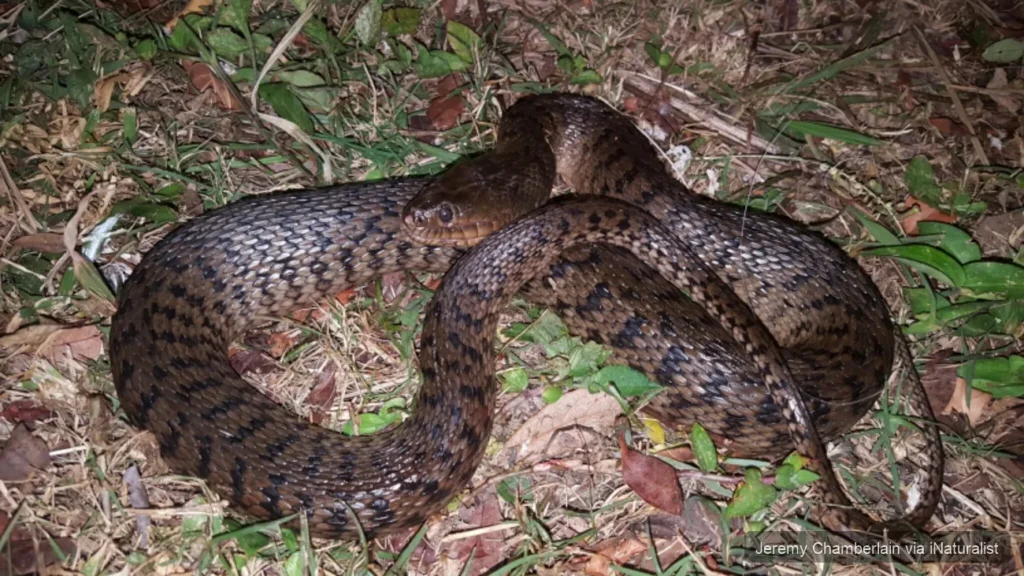
- Scientific name: Nerodia floridana
- Family: Colubridae
This robust snake varies from dark green to olive, often showing darker crossbands or blotches on its back and sides. Keeled scales give it a slightly rough texture, and the broad head has round pupils. Adults typically measure 24 to 36 inches (61 to 91 cm), with females generally larger.
Found near freshwater habitats such as ponds, marshes, and slow-moving streams, it is frequently seen swimming or resting at the water’s edge, hunting fish and amphibians. Active mostly during warmer months, it poses no threat to humans and uses constriction to capture prey. Its strong swimming ability and aquatic preference set it apart from other regional snakes.
Florida Kingsnake (Eastern Kingsnake)
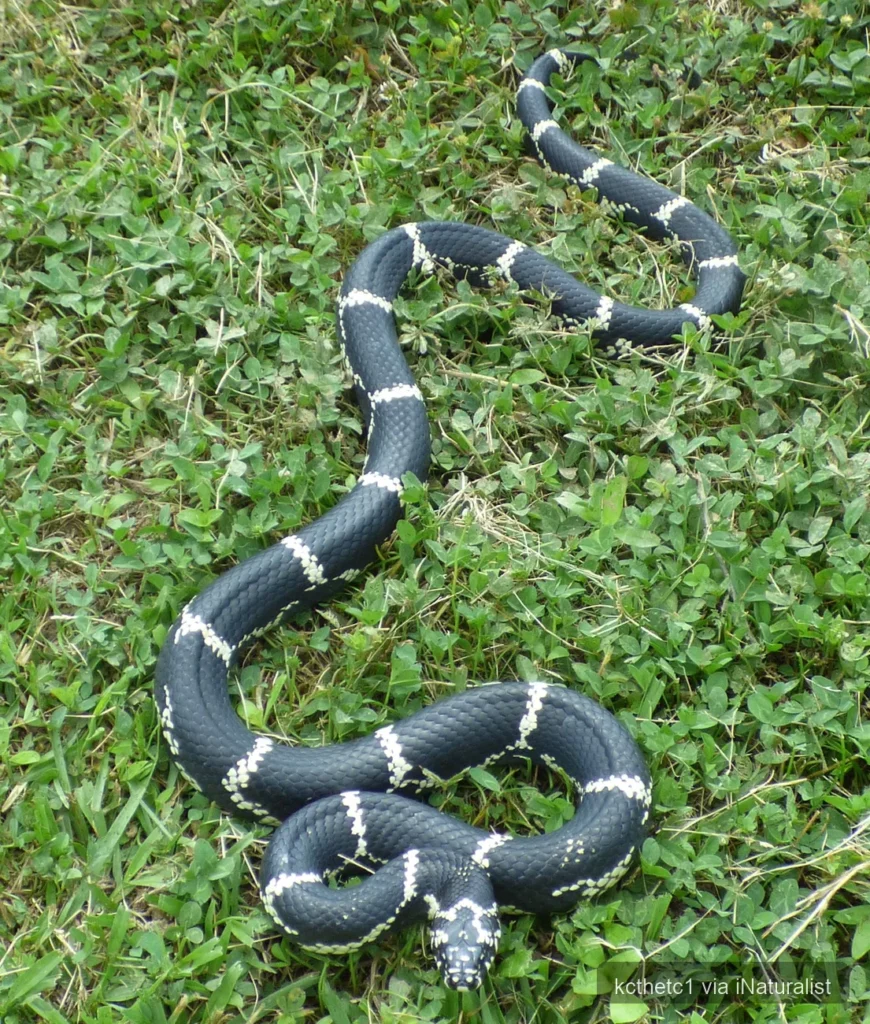
- Scientific name: Lampropeltis getula floridana
- Family: Colubridae
This snake inhabits various dry and moist environments including pine flatwoods, hardwood forests, and suburban areas. It has a smooth, shiny appearance with alternating black or dark brown bands and creamy yellow or white bands encircling its body. Adults range from 30 to 48 inches (76 to 122 cm), with some growing longer.
The small head is not much wider than the neck, and round pupils are present. Its distinctive, uniform banding pattern aids differentiation from other snakes. Often found on the ground or climbing low vegetation while hunting, it feeds mainly on other reptiles, including venomous snakes, using constriction.
Nonvenomous and generally not aggressive, its ability to prey on venomous snakes contributes to its ecological role.
Florida Pine Snake
Pictured below is the closely-related northern pine snake, Pituophis melanoleucus melanoleucus.
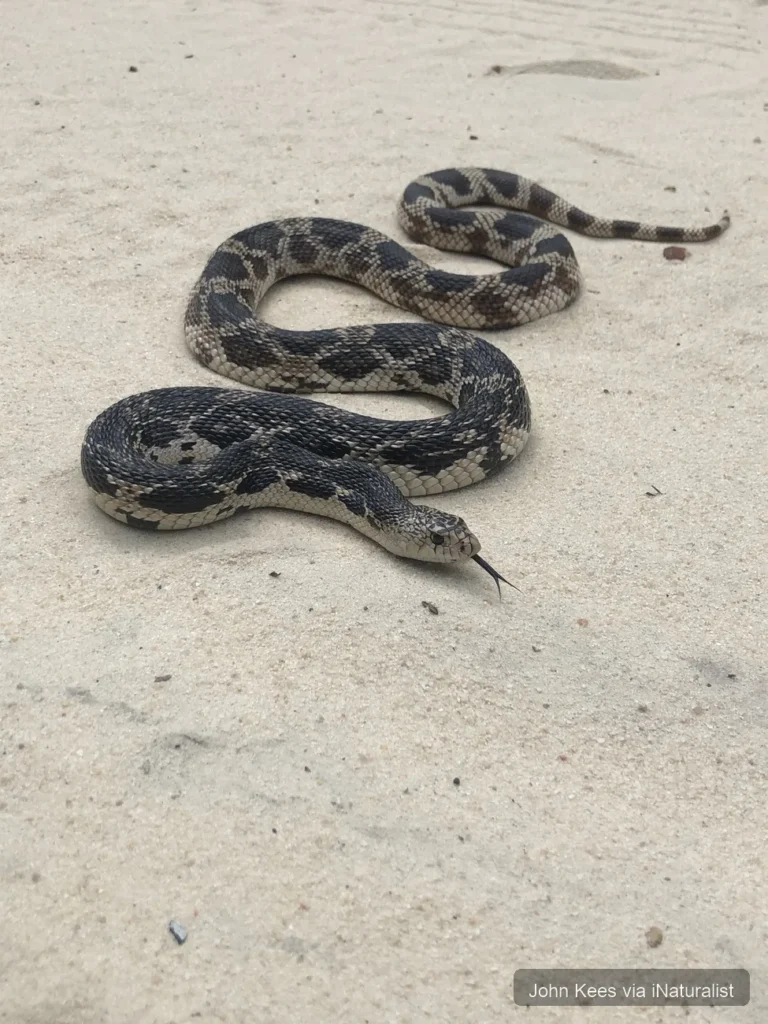
- Scientific name: Pituophis melanoleucus mugitus
- Family: Colubridae
This snake is notable for a long, slender body covered in dark blotches and stripes on a pale or yellowish background, blending well into sandy and pine-dominated landscapes. The somewhat pointed head has a distinct, narrow neck, and scales are slightly keeled. Adults measure 48 to 72 inches (122 to 183 cm), ranking among the larger regional snakes.
It inhabits dry, sandy habitats such as pine flatwoods, sandhills, and scrub, often spending time underground or moving through loose soil. It hunts primarily small mammals by constriction. Burrowing behavior and sandy habitat preference distinguish it from many other Florida snakes.
Males and females look alike, though females tend to be slightly larger. This snake plays a significant ecological role by controlling rodent populations.
Florida Redbelly Snake
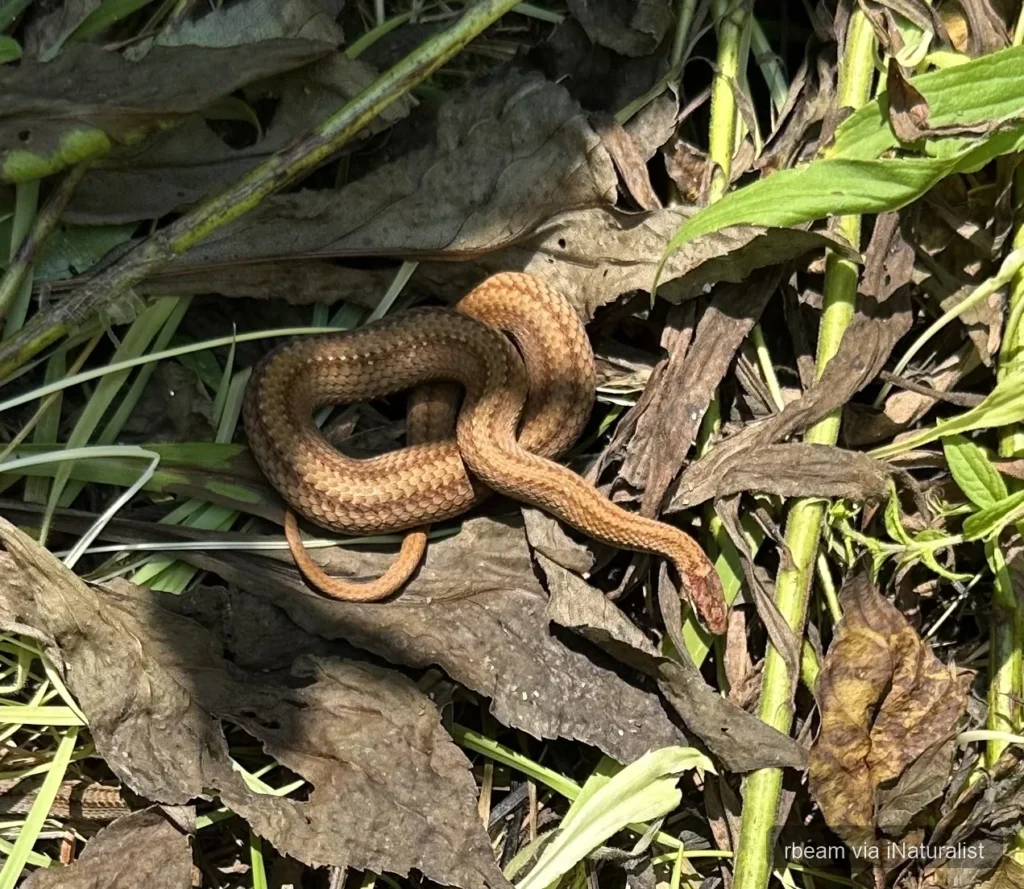
- Scientific name: Storeria occipitomaculata obscura
- Family: Colubridae
This small, slender snake measures 8 to 12 inches (20 to 30 cm) and has smooth, shiny scales. Body color ranges from grayish to brown, with a bright red or orange belly contrasting the muted dorsal tones. The small head has a slightly rounded snout and a faint dark stripe from eye to jaw.
Often found in moist environments like leaf litter, wooded areas, and damp spots near water, it remains secretive and spends much time hidden under debris or underground. The red belly may be exposed when the snake feels threatened or is handled.
Feeding mainly on small invertebrates such as worms and slugs, it is nonvenomous and harmless to humans. Its small size and distinctive red belly aid identification.
Florida Scarlet Snake
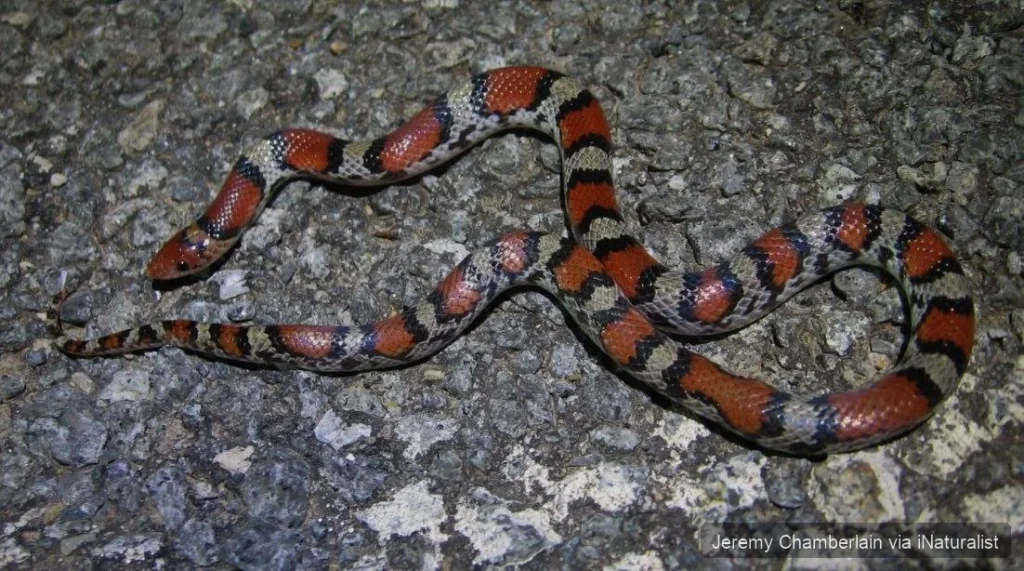
- Scientific name: Cemophora coccinea copei
- Family: Colubridae
This snake has a smooth, pale body marked with broad, bright red blotches bordered in black, creating a striking contrast against a white or light gray background. The small, rounded head blends seamlessly with the neck, and the belly is mostly pale. Adults measure 14 to 24 inches (36 to 61 cm), making it relatively small.
It spends much time burrowing in loose, sandy soils of upland habitats such as pine flatwoods, sandhills, and scrub. Due to its secretive nature and infrequent surface activity, encounters are rare. When seen, its vivid coloration and smooth scales assist identification.
Primarily feeding on reptile eggs and small underground animals, it is nonvenomous and poses no threat to humans, relying on burrowing and coloration for protection.
Florida Watersnake
- Scientific name: Nerodia fasciata pictiventris
- Family: Colubridae
Common near freshwater habitats like ponds, lakes, marshes, and slow-moving streams, this snake has a robust body typically 24 to 48 inches (61 to 122 cm) long. Its coloration includes dark brown or black bands over a lighter brown or gray background, extending along body and tail. The belly often shows reddish or orange markings, more prominent than in other subspecies.
The broad head is slightly distinct from the neck, with keeled scales giving a rough texture. When threatened, it flattens its body and may release a musk odor but rarely bites unless provoked. Nonvenomous, it primarily feeds on fish and amphibians near or in water. Its aquatic habits and patterning can cause confusion with venomous water moccasins, but it lacks their pit organs and triangular head shape.
Glossy Crayfish Snake
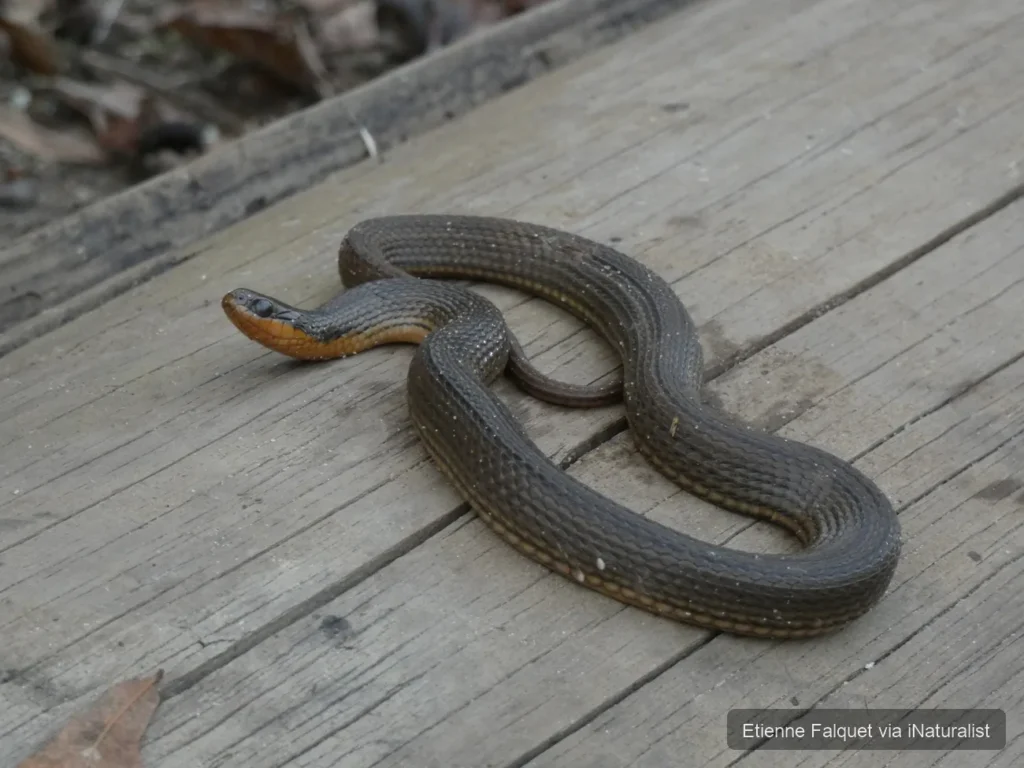
- Scientific name: Liodytes rigida
- Family: Colubridae
This glossy, slender snake has smooth, shiny scales creating a sleek appearance. Its coloration is dark olive to brown, often with faint darker crossbands and a lighter underside. The head is slightly wider than the neck without sharp distinction, and eyes are relatively small with round pupils. Adults measure 12 to 20 inches (30 to 51 cm).
Closely associated with slow-moving or still waters such as swamps, marshes, and ditches abundant in crayfish, it is often seen swimming or foraging near submerged vegetation and debris. Its diet consists almost exclusively of crayfish, captured using specialized underwater hunting.
Due to its aquatic habits and glossy scales, it may be mistaken for other water snakes but is generally smaller with a more uniform, shiny surface. Nonvenomous, it poses no threat to humans.
Mud Snake
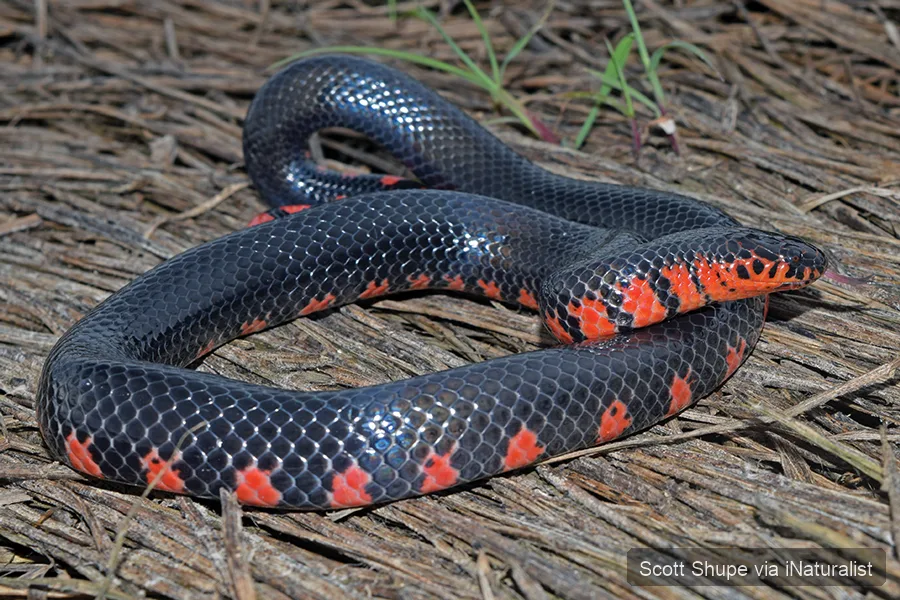
- Scientific name: Farancia abacura
- Family: Colubridae
This moderately sized, slender snake measures 20 to 36 inches (51 to 91 cm) long. Its smooth, glossy scales display a distinctive pattern with a dark, shiny black or deep brown back and a bright red or coral-colored belly. The cylindrical body has a relatively small head blending smoothly into the neck without pronounced widening.
Often found in wet, muddy habitats such as swamps, marshes, and slow-moving streams, it spends much time in or near water, hunting amphibians and small aquatic creatures. The bright belly is a useful identification feature, especially when the snake coils defensively to reveal its underside.
Ringneck Snake (Ring-Necked Snake)
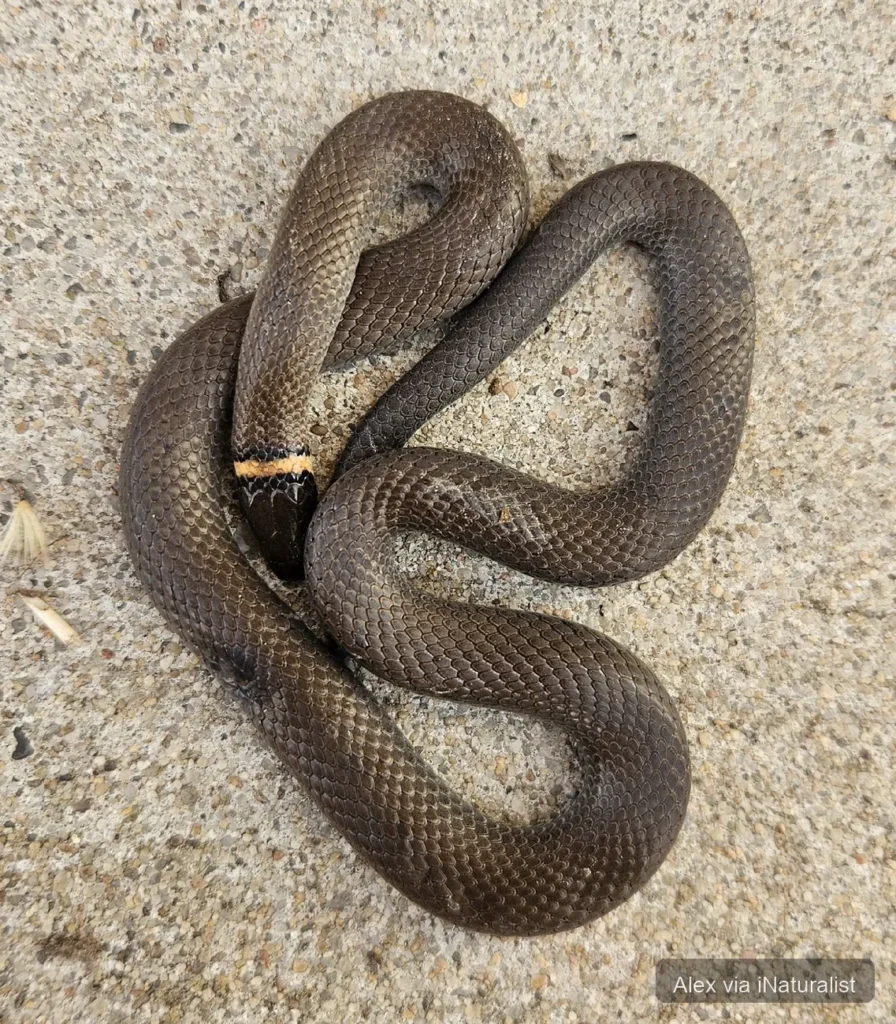
- Scientific name: Diadophis punctatus
- Family: Dipsadidae
This small, slender snake has smooth, shiny scales and a distinctive yellow or orange ring around the neck contrasting with a mostly dark gray to black back. Its belly is bright yellow or orange, often marked with black spots or irregular patterns. Adults measure 10 to 15 inches (25 to 38 cm), noticeably smaller than many other snakes.
It inhabits moist environments such as forests, wetlands, and near water, hiding under leaf litter, logs, or stones.
Secretive and primarily nocturnal, it is rarely seen during the day except after rain. Its diet mainly includes small amphibians, insects, and other invertebrates. When threatened, it may curl its tail to display the brightly colored underside as a warning.
Nonvenomous, it feeds on small prey such as amphibians, insects, and other invertebrates. The neck ring and colorful belly assist in distinguishing it from other small snakes in Florida.
In mainland Florida, it is generally the southern ringneck snake subspecies that is found. The Key ringneck snake is found in the lower Florida Keys, especially Monroe County.
Rough Green Snake
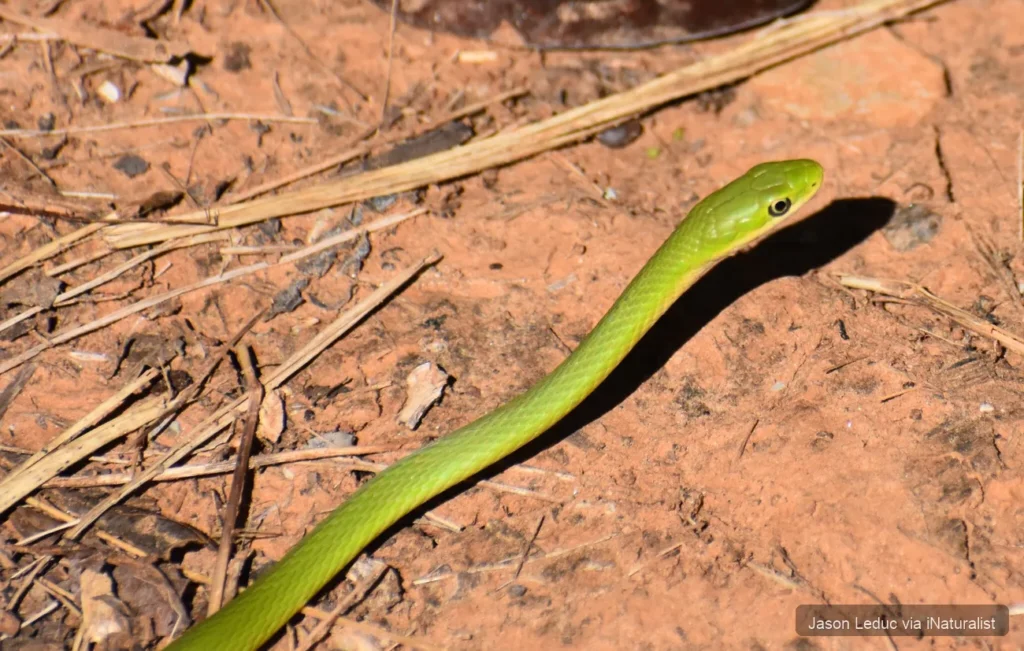
- Scientific name: Opheodrys aestivus
- Family: Colubridae
This slender snake is often spotted in shrubs, trees, and low vegetation, where its bright green color blends with leaves and grass. Adults measure 18 to 30 inches (46 to 76 cm). Its rough-textured scales give a matte rather than shiny appearance, and the undersides are pale yellow or whitish.
The small, pointed head is distinct from the neck, with relatively large eyes and round pupils. The rough scales and uniform green coloration on back and sides help differentiate it from smoother-scaled green snakes. It frequents open wooded areas, gardens, and near water, hunting insects and spiders.
Nonvenomous and primarily arboreal, it often climbs branches and vines. Active during the day, it is easier to observe resting or moving through foliage.
Scarlet Kingsnake
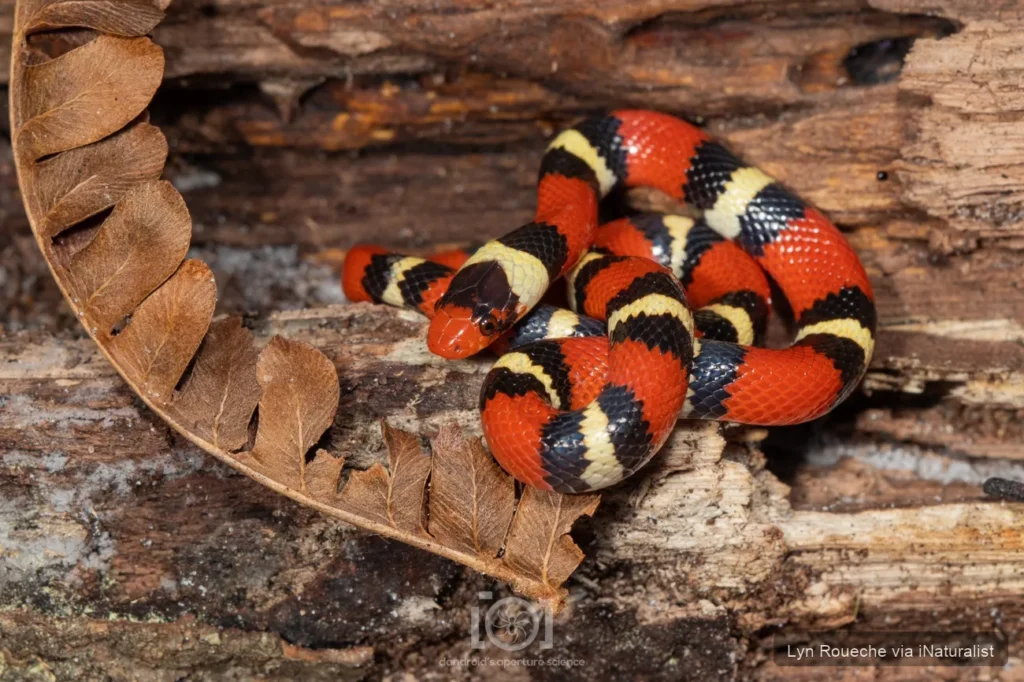
- Scientific name: Lampropeltis elapsoides
- Family: Colubridae
This small, slender snake displays a distinctive pattern of red, black, and yellow bands encircling its body. Red bands are bordered by black, with yellow bands separating black and red, closely resembling the venomous coral snake. However, the scarlet kingsnake’s red bands touch black bands, unlike the coral snake where red bands touch yellow. Adults measure 14 to 27 inches (36 to 69 cm).
Most often found in dry, sandy woodlands, pine flatwoods, and wetland edges, it spends much time beneath leaf litter, logs, or ground cover. Secretive and primarily terrestrial, it moves quietly on the forest floor, emerging mostly at night or during wet weather.
Nonvenomous, it preys on small reptiles including other snakes and lizards, as well as amphibians. Its coloration serves as protective mimicry, deterring predators by imitating venomous coral snakes in the region.
Striped Crayfish Snake
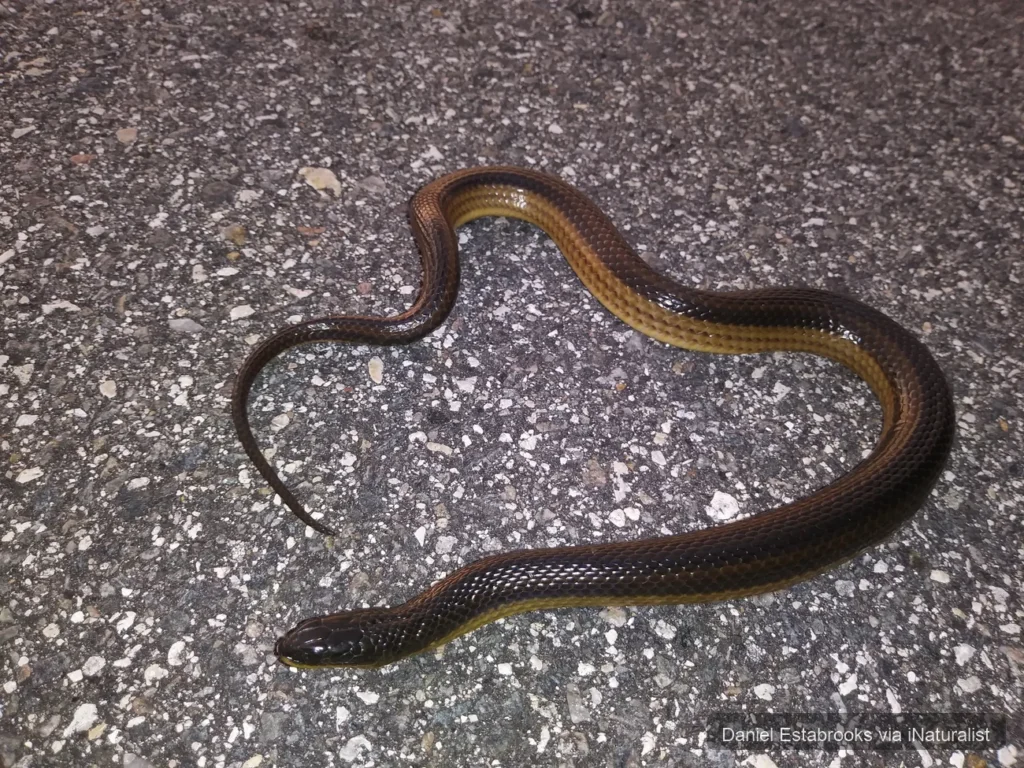
- Scientific name: Liodytes alleni
- Family: Colubridae
This slender snake has a smooth, glossy body marked with three distinct yellow stripes running lengthwise on a dark brown to black background. These stripes—one down the center of the back and one on each side—help distinguish it from other Florida snakes. Adults measure 15 to 24 inches (38 to 61 cm).
Closely associated with freshwater habitats such as slow-moving streams, swamps, and marshes, it spends much time swimming or hiding among aquatic vegetation. It primarily hunts crayfish and other small aquatic prey. Due to its secretive aquatic habits, it is infrequently seen by people.
Further Reading
Florida Wildlife
- Discover the bird life of Florida on this page: Florida Birds
- Discover the scorpions found in Florida: Florida Scorpions
- Discover the lizards of Florida: Florida Lizards
Snakes & Reptiles
- You can find out more about snakes on this page: Snake Facts
- Discover different types of snakes on this page: Types of Snakes
- You can find out more about reptiles on this page: Reptiles – The Ultimate Guide
- Discover different types of reptiles on this page: Types of Reptiles