
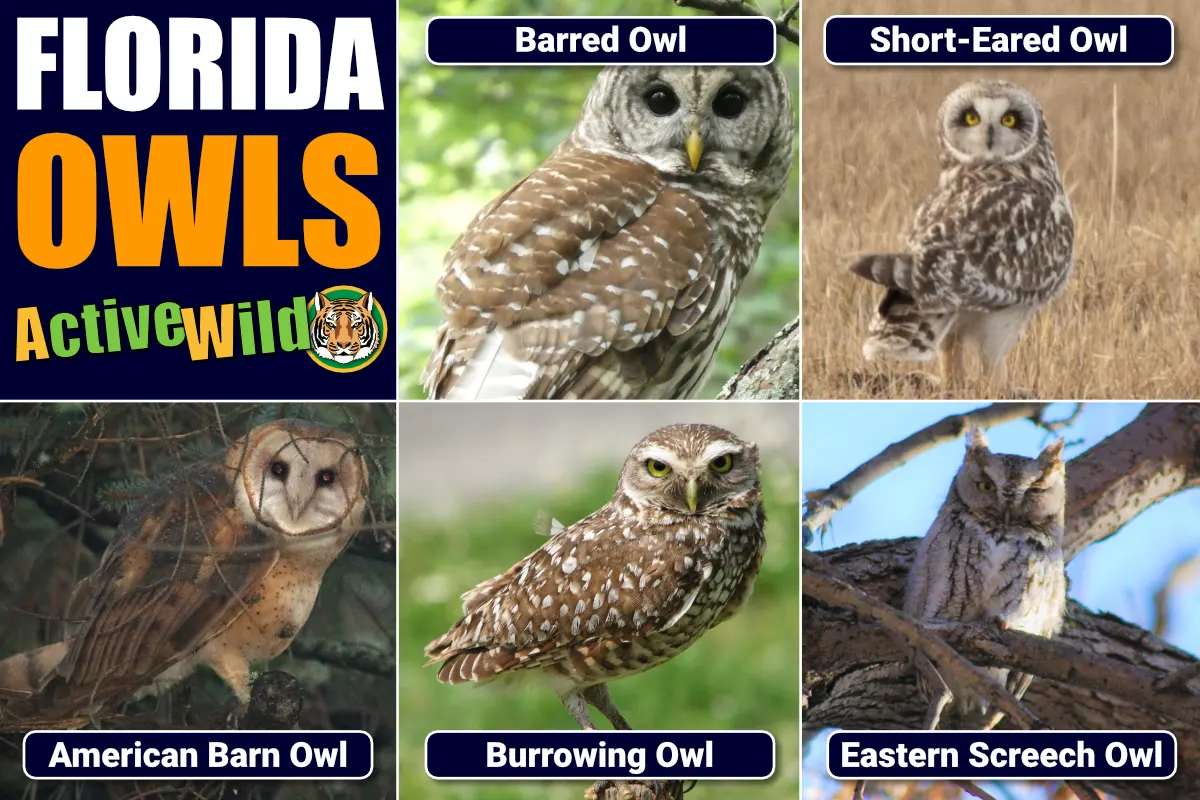
Florida owls inhabit a wide range of habitats across the Sunshine State, from dense forests and swamps to suburban neighborhoods. In this guide, we’ll explore the different Florida owls you may encounter, including their identification features, habitats, and behaviors.
Owls in Florida play an important role in their ecosystems by helping control populations of rodents and other small animals, which helps maintain ecological balance.
As predators, owls are also indicators of healthy habitats and contribute to the stability of food webs across forests, wetlands, and grasslands.
This guide focuses on a representative selection of owls commonly found in Florida, including the American Barn Owl, Barred Owl, and Great Horned Owl, among others…
Page Index
American Barn Owl
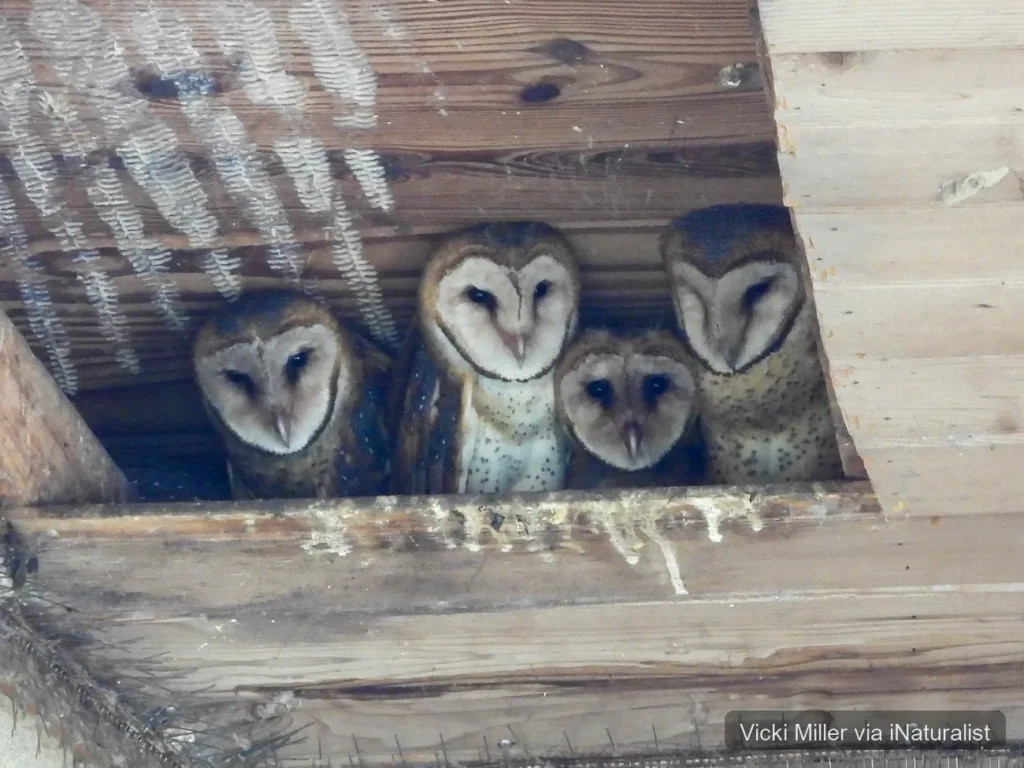
- Scientific name: Tyto furcata
- Rank: species
The American Barn Owl is easily recognized by its distinctive heart-shaped, white face, which contrasts with its golden-buff and gray upperparts. Its underparts are pale with some small dark spots. This owl has long wings and a short tail, measuring about 13 to 15 inches in length with a wingspan of approximately 42 inches. Its dark eyes stand out against the pale facial disc.
Commonly found in open habitats such as farmland, grasslands, and marsh edges, the American barn owl often roosts in barns, abandoned buildings, or tree cavities. It is most active at night and can be detected by its silent flight and screeching call.
Both sexes look similar, although females may have slightly darker and more spotted underparts. The combination of the heart-shaped face and light coloration makes this species distinctive among owls in Florida.
Barred Owl
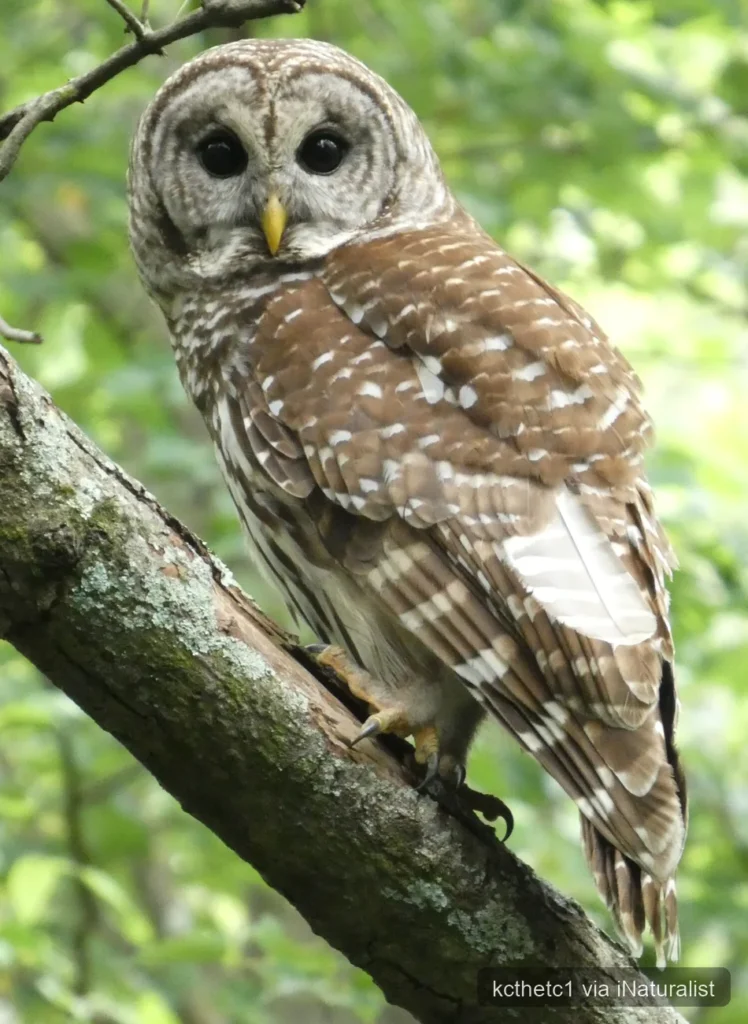
- Scientific name: Strix varia
- Family: Strigidae
- Rank: species
The Barred Owl has a rounded head without ear tufts and a distinctive pattern of horizontal brown and white bars across its chest and vertical streaks on its belly. Its face is pale with dark eyes, set within a round facial disk.
Adults typically measure 16 to 25 inches in length, with a wingspan of about 38 to 49 inches, making it a medium to large-sized owl.
In Florida, this species is most often found in mature forests, especially near water sources like swamps and river bottoms. It prefers dense woodlands where it can perch quietly during the day. The Barred Owl’s hooting call and its barred plumage are key identification clues. Males and females look alike.
Burrowing Owl
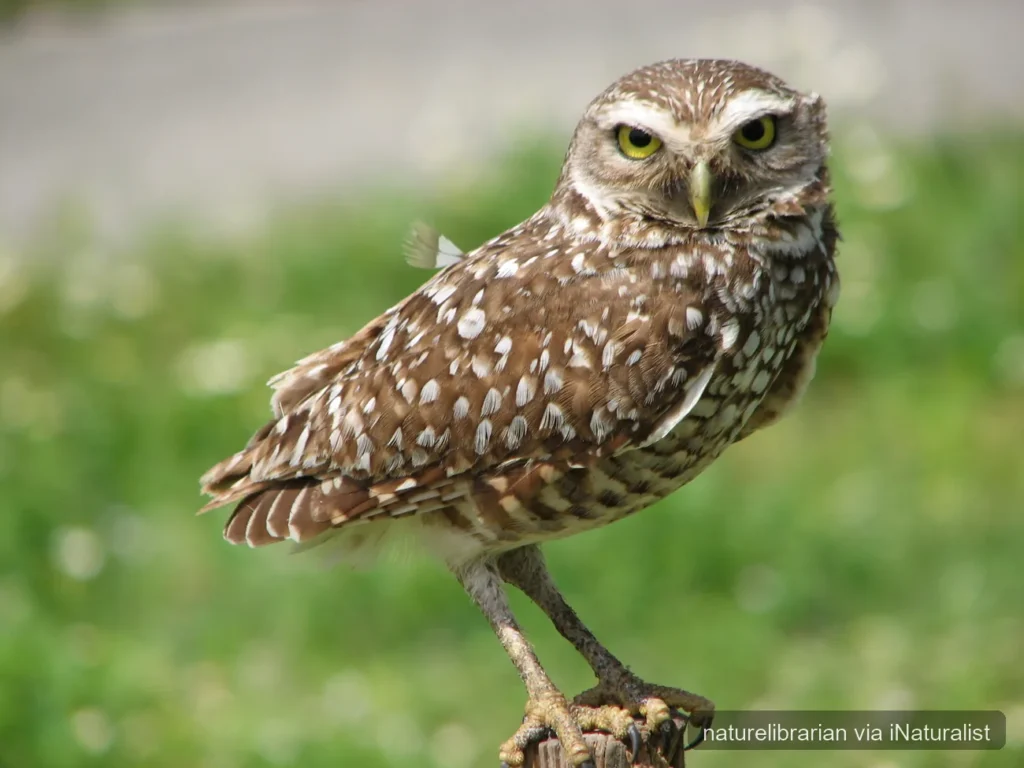
- Scientific name: Athene cunicularia
- Family: Strigidae
- Rank: species
Burrowing Owls are small, ground-dwelling owls commonly found in open landscapes such as grasslands, prairies, and agricultural areas throughout Florida. They often inhabit abandoned burrows made by mammals, which they use for nesting and shelter.
Burrowing owls are active during the day and night, making them easier to spot than many other owl species.
Measuring about 7 to 10 inches in length with a wingspan of roughly 20 to 24 inches, these small owls have long legs and a slim body. Their brown and white mottled plumage provides camouflage against the ground, while their round heads lack ear tufts.
Bright yellow eyes and distinctive white “eyebrows” above them help with identification. Both males and females look similar, though males may appear slightly paler. Their behavior of perching on low posts or near burrow entrances is also a helpful clue to their presence.
Eastern Screech-Owl

- Scientific name: Megascops asio
- Family: Strigidae
- Rank: species
The Eastern Screech-Owl is a small owl with prominent ear tufts and a compact body measuring about 6 to 10 inches in length. Its plumage varies between gray and reddish-brown morphs, both featuring intricate mottling and streaks that provide excellent camouflage against tree bark. The facial disk is rounded with yellow eyes and a subtle white outline, helping to distinguish it from other small owls.
In Florida, this species is commonly found in wooded areas, including suburban neighborhoods, parks, and forests. It prefers cavities or tree holes for nesting.
The Eastern Screech-Owl’s size, ear tufts, and mottled coloration are key identification clues. Males and females look alike.
Great Horned Owl

- Scientific name: Bubo virginianus
- Family: Strigidae
- Rank: species
The Great Horned Owl is a large, robust bird measuring about 18 to 25 inches in length, with a wingspan ranging from 3.3 to 4.8 feet. It has a rounded head with prominent, pointed ear tufts that resemble horns, giving the species its common name. Its plumage is mottled brown and gray with a white patch on the throat, and bright yellow eyes set in a broad facial disk.
In Florida, Great Horned Owls inhabit a variety of environments including forests, swamps, and suburban areas with large trees. They are often found perched quietly in dense foliage during the day. Their large size, ear tufts, and deep hooting call are key identification features. Males and females look similar, though females tend to be slightly larger.
Long-Eared Owl
- Scientific name: Asio otus
- Family: Strigidae
- Rank: species
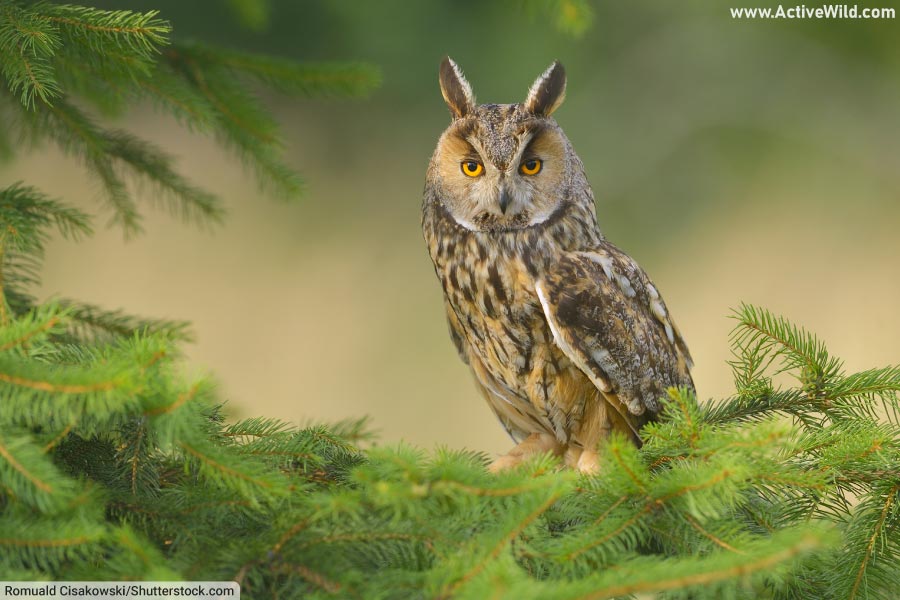
The Long-eared Owl is a medium-sized owl with long, narrow ear tufts that stand upright, giving it a slender silhouette. Its plumage is mottled brown and buff with streaks on the chest and belly, providing camouflage against tree bark.
The facial disk is pale with darker edges and orange-yellow eyes, which help distinguish it from other owls. This species measures about 13 to 16 inches in length with a wingspan around 35 to 40 inches.
In Florida, the Long-eared Owl is typically found in dense woodlands, pine forests, and groves, often roosting in thick conifers during the day. It is more likely to be seen or heard at dusk or night. Identification is aided by its slim body shape, prominent ear tufts, and streaked underparts. Males and females appear alike.
Northern Saw-Whet Owl
- Scientific name: Aegolius acadicus
- Family: Strigidae
- Rank: species
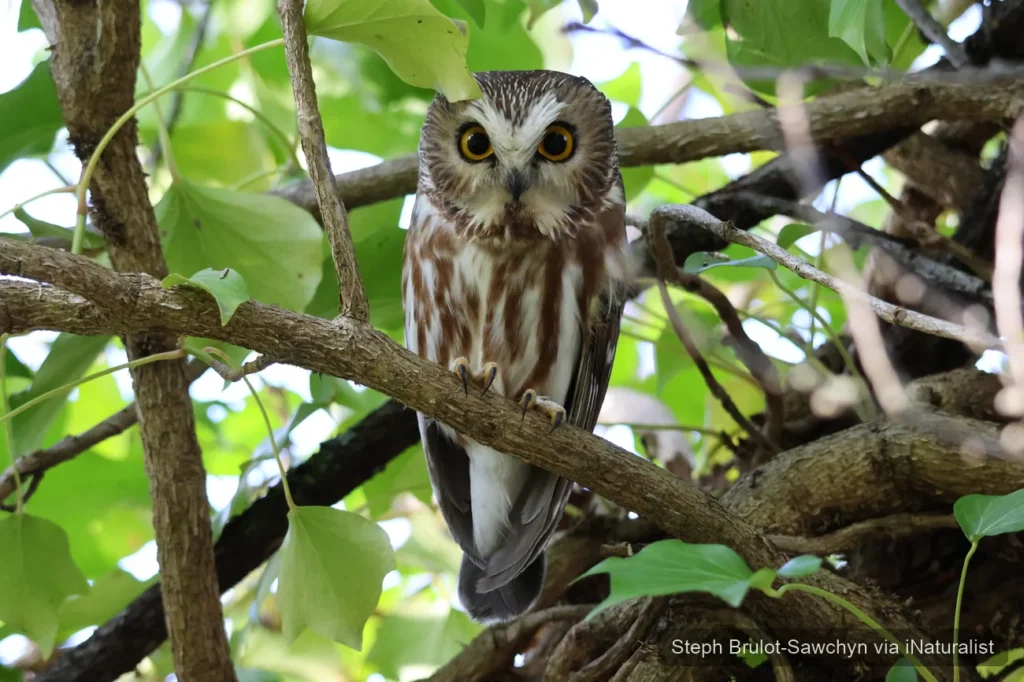
The Northern Saw-whet Owl is a small, compact owl measuring about 7 to 8 inches in length with a wingspan of roughly 16 to 20 inches. It has a rounded head without ear tufts, large yellow eyes, and a white facial disk bordered by brown. Its plumage is brown with white spots on the head and upperparts, and its underparts are pale with fine streaks.
The Northern Saw-whet Owl is found in mixed woodlands, often in dense forests with conifers or hardwoods. It is primarily nocturnal and can be heard during the breeding season by its repetitive, high-pitched tooting call. Males and females are similar in appearance.
Short-Eared Owl

- Scientific name: Asio flammeus
- Family: Strigidae
- Rank: species
The Short-eared Owl is a medium-sized owl measuring about 13 to 17 inches in length with a wingspan of 33 to 43 inches. It is best identified by its rounded head with small, barely visible ear tufts and striking yellow eyes set in a pale facial disk outlined with dark rims. Its mottled brown and buff plumage features streaked underparts and a distinctive white patch on the upper wings visible in flight.
This species is commonly found in open habitats such as grasslands, marshes, and prairies across Florida. It often hunts during the day or at dusk, making it more likely to be seen than many other owls. The Short-eared Owl’s low, buoyant flight and habit of perching on the ground or fence posts can aid identification. Males and females look similar.
Further Reading
You can find out more about Florida bird life on the following pages:
Discover more about wildlife in Florida:
Learn about different types of owls: