
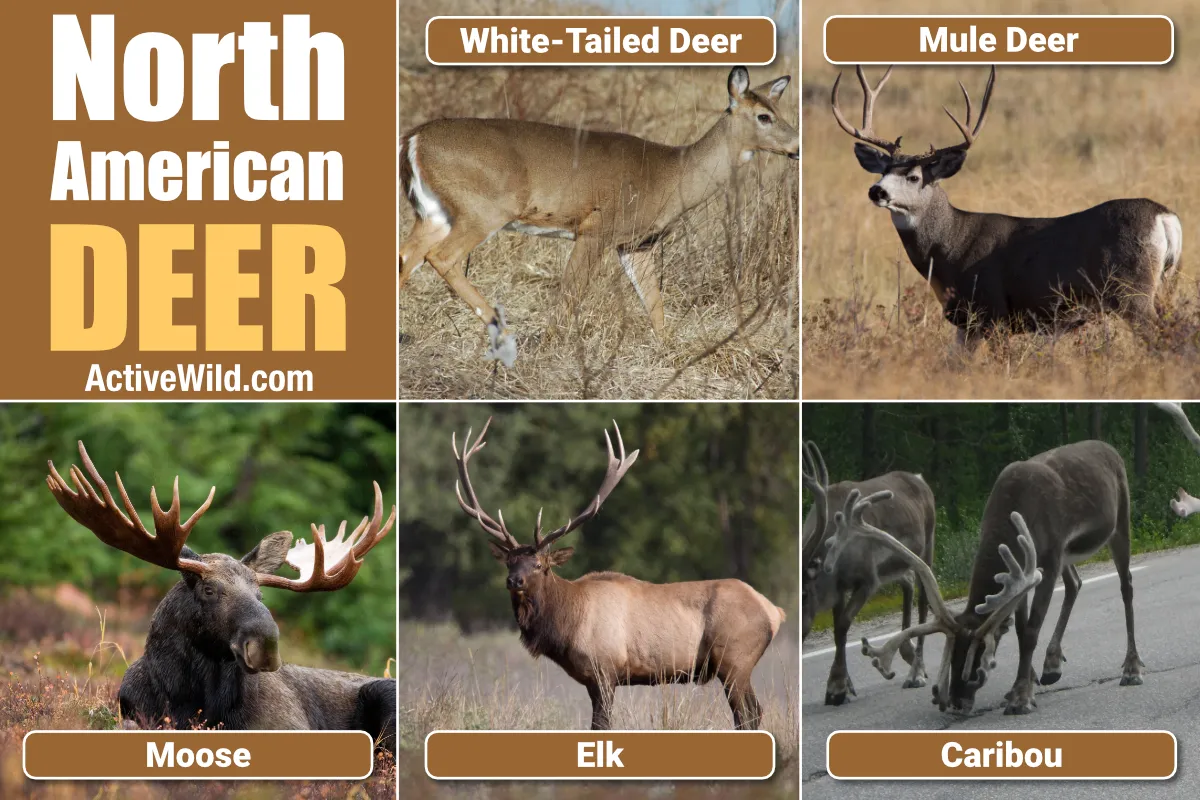
Deer are among the most familiar and widespread wild mammals in North America, and several different types live in the United States. From the small, elusive Key deer of Florida to the towering moose of Alaska, the country is home to a diverse range of deer species and subspecies adapted to the country’s forests, mountains, deserts, and tundra.
In this guide, we’ll explore all the types of deer in the US, including native species, regional subspecies, and non-native / introduced deer species that can be found in parts of the country.
Whether you’re curious about identification, distribution, or simply want a complete list of deer species in North America, this article provides a clear and comprehensive overview.
Page Index
How Many Deer Species Are in the United States?
There are five native deer species in the United States: white-tailed deer, mule deer, elk (wapiti), moose, and caribou (reindeer). These species occur naturally across different regions of the country, from forests and mountains to tundra and wetlands.
In addition to these native species, there are several introduced deer species—including axis deer, sika deer, and fallow deer—that have established wild populations in certain areas, particularly in Texas, California, and Hawaii.
If you include both native and introduced species, there are around 10–12 types of deer found in the United States, depending on how populations are classified. Beyond this, there are also numerous subspecies, especially of white-tailed deer and mule deer, which add even more diversity at a regional level.
Native Deer Species of the United States
White-tailed Deer (Odocoileus virginianus)

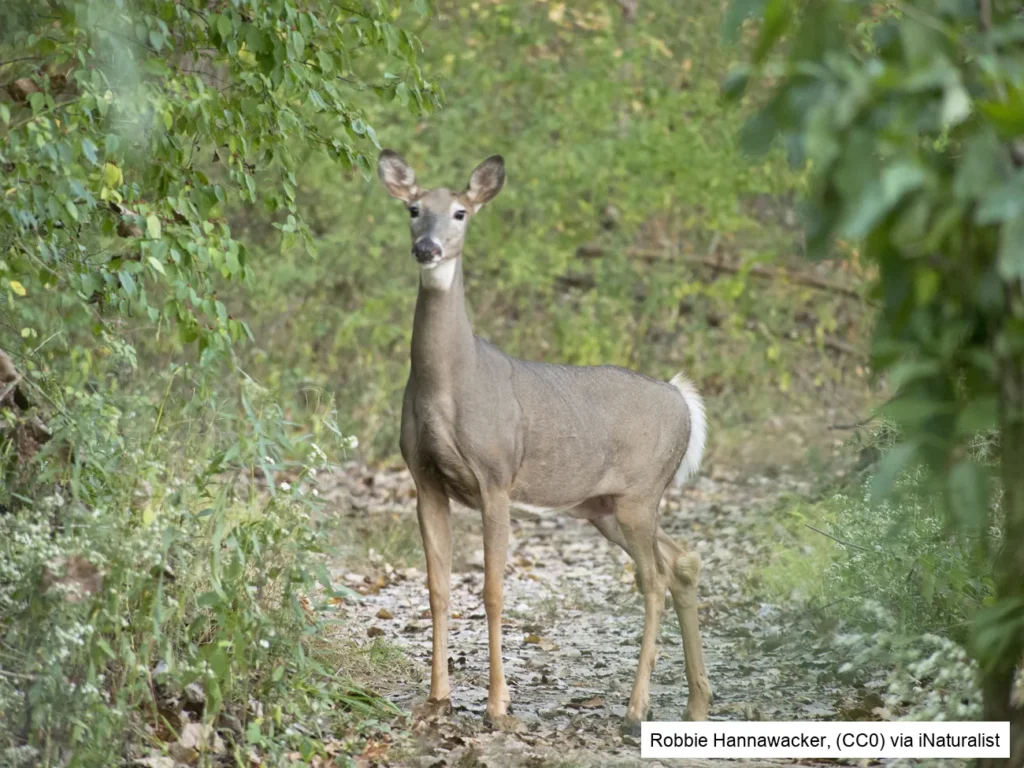
The white-tailed deer is the most common deer species in the United States and one of the most adaptable large mammals in North America.
- Quick facts: Active mainly at dawn and dusk; males (bucks) grow and shed antlers annually.
- Range: Found across most of the U.S., southern Canada, Central America and into South America, in habitats from forests to farmland and suburbs.
- Size / ID guide: Typically 3–3.5 ft (0.9–1.1 m) at the shoulder. Recognised by its brown coat, white underside, and distinctive raised white tail when alarmed. Bucks have branched antlers that grow upward and outward from a single main beam, with multiple tines (points) that increase with age.
Find out more about the white-tailed deer on this page: White-Tailed Deer
Mule Deer (Odocoileus hemionus)
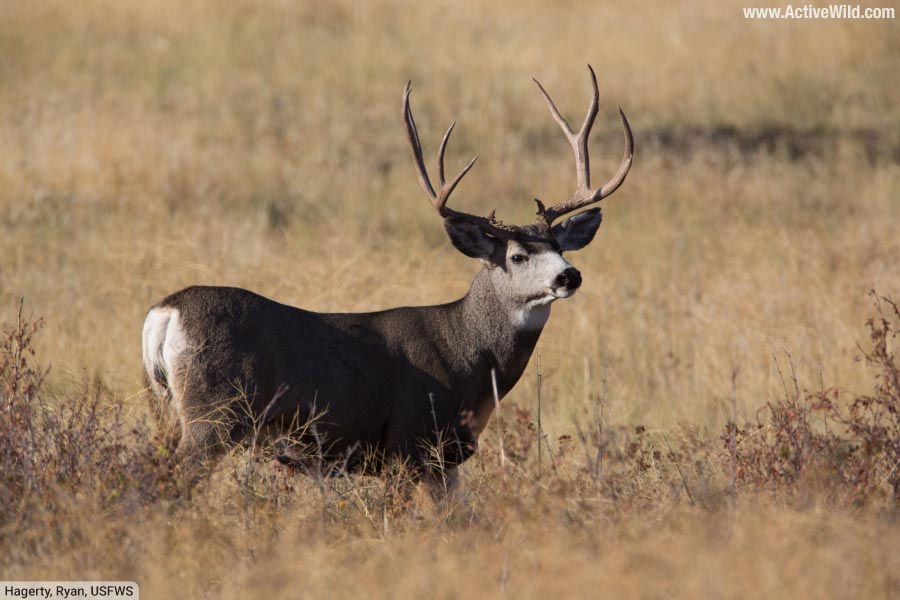
The mule deer is a widespread deer of western North America, named for its large, mule-like ears. It is well adapted to a variety of habitats, from open plains to mountainous and desert regions.
Several subspecies exist, including black-tailed deer forms along the Pacific coast and desert-adapted populations in the Southwest, which will be explored later in this article.
- Quick facts: Most active at dawn and dusk; known for its distinctive bounding “stotting” gait when fleeing predators.
- Range: Found throughout the western United States, from the Great Plains to the Pacific Coast, and north into western Canada.
- Size / ID guide: Typically 3–3.5 ft (0.9–1.1 m) at the shoulder. Recognised by its greyish-brown coat, large ears, black-tipped tail, and white rump patch. Bucks have forked (bifurcating) antlers that split into two branches, often branching again as they grow.
Find out more about the mule deer on this page: Mule Deer
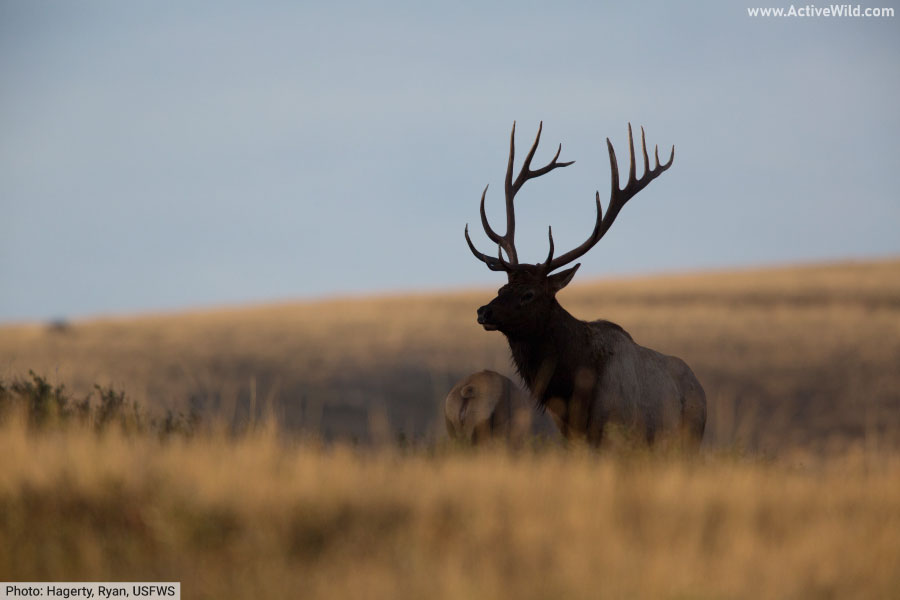
Elk (Wapiti) (Cervus canadensis)
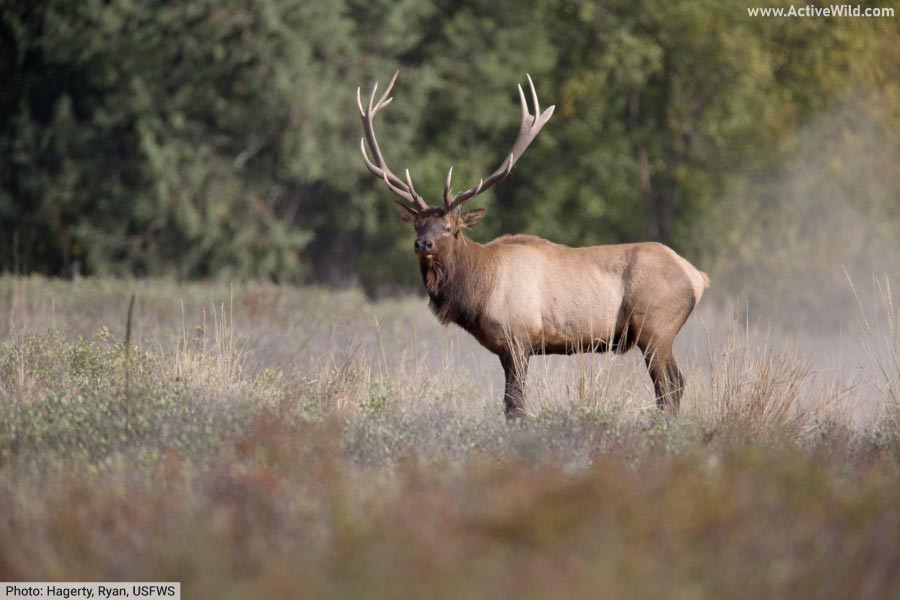
The elk is the world’s second-largest deer species and a characteristic animal of North America’s forests, mountains, and grasslands. Once widespread, elk have been successfully reintroduced to many parts of their former range.
- Quick facts: Highly social, often forming large herds; males (bulls) are known for their loud bugling calls during the autumn rut.
- Range: Found mainly in the western United States, especially in the Rocky Mountains, with smaller reintroduced populations in the Midwest and eastern states such as Pennsylvania and North Carolina. (The species is also found in Asia.)
- Size / ID guide: Typically 4–5 ft (1.2–1.5 m) at the shoulder. Recognised by a tan body with a darker neck and a pale rump patch. Bulls have very large, sweeping antlers that branch into multiple tines, often forming an impressive, symmetrical rack.
Find out more about the elk on this page: Elk
Moose (Alces alces)
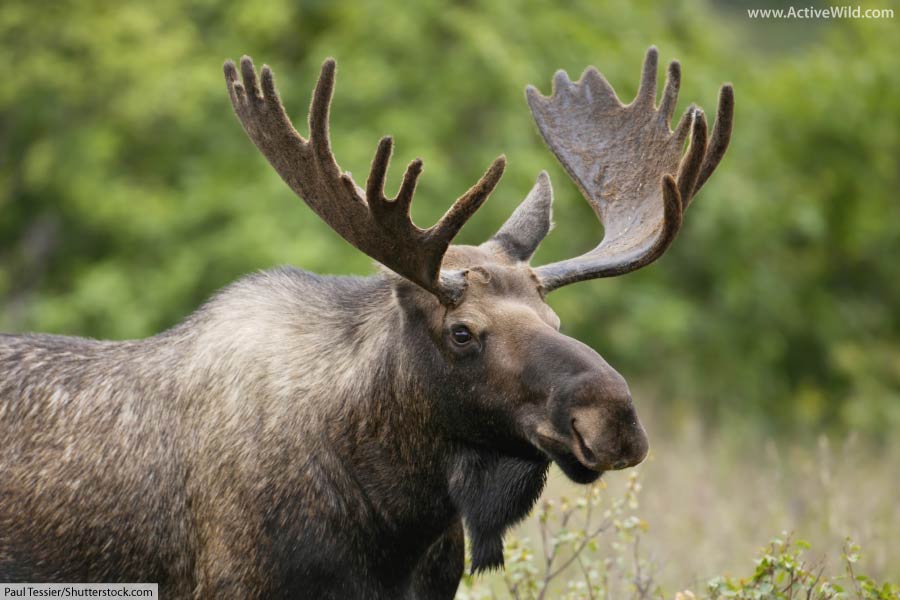
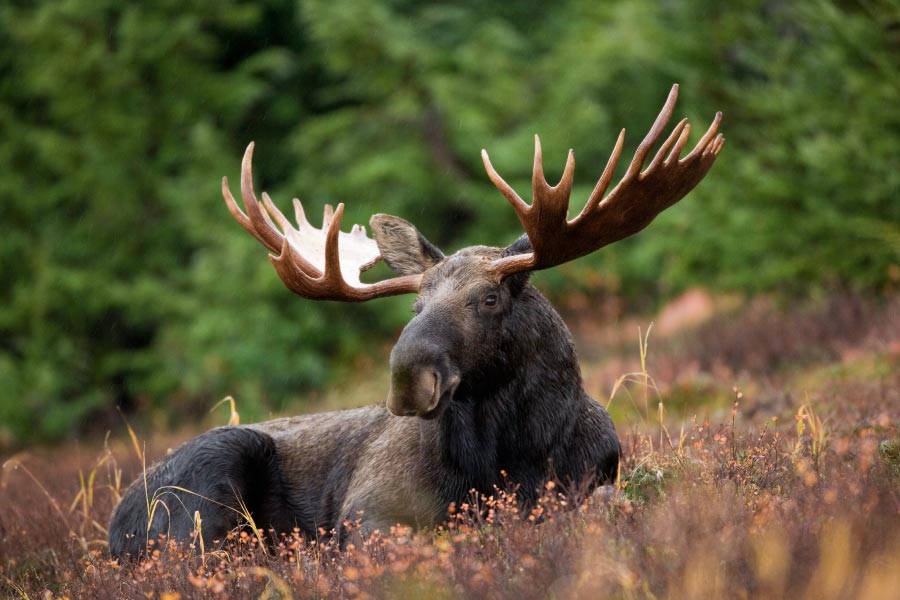
The moose is the largest member of the deer family and a powerful, cold-adapted species of northern forests and wetlands. Solitary by nature, moose are strong swimmers and are often seen feeding on aquatic vegetation.
- Quick facts: Mostly solitary; excellent swimmers capable of diving underwater to feed.
- Range: Found throughout Alaska and much of Canada, with smaller populations in the northern United States, including New England, the northern Rockies, and parts of the upper Midwest.
- Size / ID guide: Typically 5–6.5 ft (1.5–2 m) at the shoulder. Recognised by its long legs, humped shoulders, and elongated, drooping snout. Bulls have broad, flattened (palmate) antlers that can span over 6 ft (1.8 m), making them unmistakable.
Find out more about the moose on this page: Moose
Caribou (Reindeer) (Rangifer tarandus)
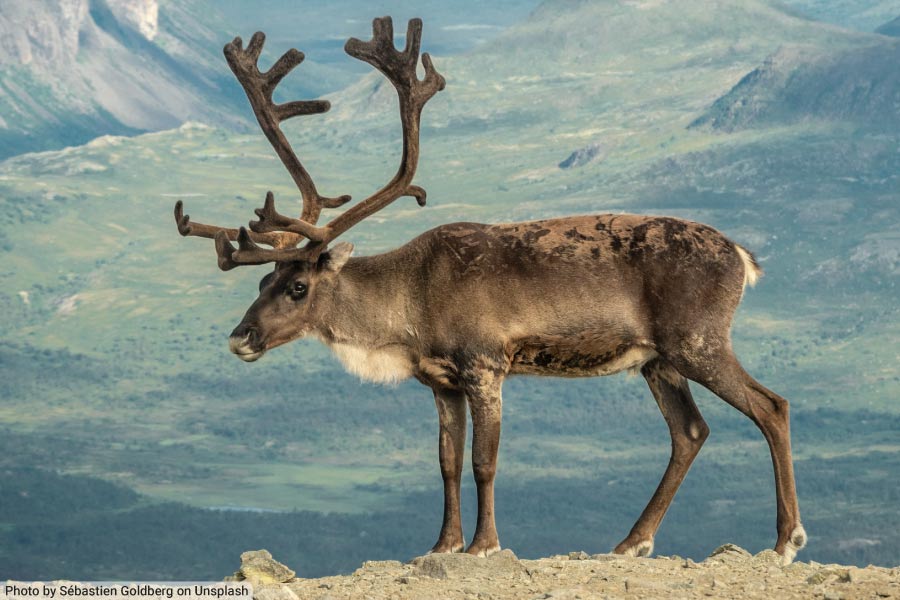
Caribou are uniquely adapted deer of the far north, famous for their long migrations and ability to survive in harsh Arctic conditions. They are the only deer species in which both males and females can grow antlers.
- Quick facts: Highly migratory; both sexes grow antlers (rare among deer).
- Range: Found in Alaska and across northern Canada, inhabiting tundra and boreal forest regions; absent from the contiguous United States today. The species is also found in Eurasia.
- Size / ID guide: Typically 3.5–4.5 ft (1.1–1.4 m) at the shoulder. Recognised by a thick, pale brown coat, large hooves adapted for snow and soft ground, and a relatively compact build. Antlers are long and irregular, often with forward-pointing brow tines and multiple branches.
Find out more about caribou / reindeer on this page: Caribou
Mule Deer vs Black-Tailed Deer
Black-tailed, or blacktail deer are not a separate species but are generally considered subspecies of the mule deer.
The two recognised subspecies of black-tailed deer are: the Columbian black-tailed deer (O. h. columbianus) and the Sitka black-tailed deer (O. h. sitkensis).
They are closely related and share many core traits, including large ears and forked antlers. However, black-tailed deer are typically smaller in size, and tend to inhabit dense coastal forests along the Pacific Northwest, while mule deer are more commonly found in open, arid, and mountainous regions.
Where their ranges meet, the two forms can interbreed, and some scientists view them as part of a continuous spectrum rather than clearly distinct types.
Common White-tailed Deer Subspecies in the United States
White-tailed deer (Odocoileus virginianus) are divided into numerous regional subspecies, many of which differ slightly in size, coloration, and habitat preference. In the northern U.S., the northern white-tailed deer (O. v. borealis) is typically larger, with a thicker coat adapted to colder climates. In contrast, the southern white-tailed deer (O. v. osceola) of the Southeast tends to be smaller and lighter in build. The Texas white-tailed deer (O. v. texanus) is one of the most widespread and abundant forms, common across the South-Central U.S.
In the Great Plains, the plains white-tailed deer (O. v. macrourus) occupies open habitats, while the Columbian white-tailed deer (O. v. leucurus) is a rare, protected subspecies of the Pacific Northwest. The tiny Key deer (O. v. clavium) is restricted to the Florida Keys, and the Coues deer (O. v. couesi) inhabits the arid Southwest, adapted to rugged, dry environments.
Mule Deer Subspecies in the United States
Mule deer (Odocoileus hemionus) are divided into several regional subspecies, adapted to different environments across western North America. The Rocky Mountain mule deer (O. h. hemionus) is the most widespread form, found across mountainous and semi-arid regions. Along the Pacific Coast, the Columbian black-tailed deer (O. h. columbianus) inhabits dense forests and has a darker coat and smaller body size. Farther north, the Sitka black-tailed deer (O. h. sitkensis) lives in coastal Alaska, adapted to wet, rugged habitats.
In California, the California mule deer (O. h. californicus) occupies varied landscapes from foothills to forests, while the desert mule deer (O. h. crooki) is adapted to hot, arid environments in the Southwest. Despite these regional differences, all mule deer share key features such as large ears and forked antlers, with subspecies often intergrading where their ranges meet.
Introduced Deer Species in the United States
Axis Deer (Chital) (Axis axis)
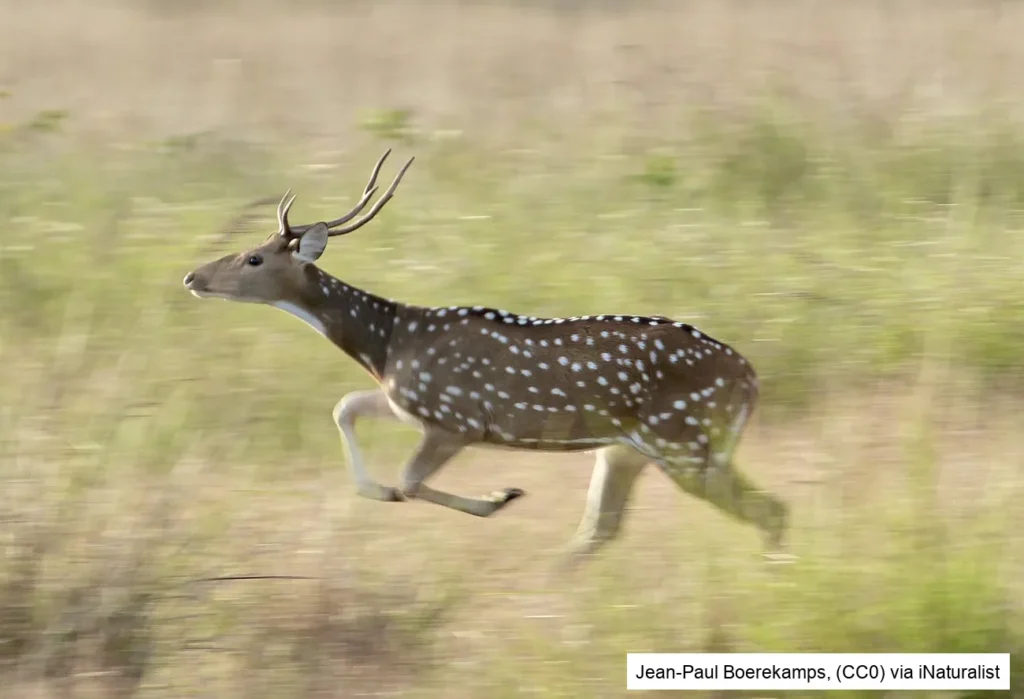
The axis deer is a striking, non-native species introduced to the United States from India, now well established in parts of Texas and Hawaii.
- Quick facts: Often active day and night; highly social, forming herds.
- Range: Found mainly in Texas (especially on ranchlands) and across the Hawaiian Islands.
- Size / ID guide: Typically 2.5–3 ft (0.8–0.9 m) at the shoulder. Recognised by its rich reddish-brown coat covered in permanent white spots and a white underbelly. Males have long, slender antlers with three main tines (points), usually sweeping upward in a graceful curve.
Sika Deer (Cervus nippon)
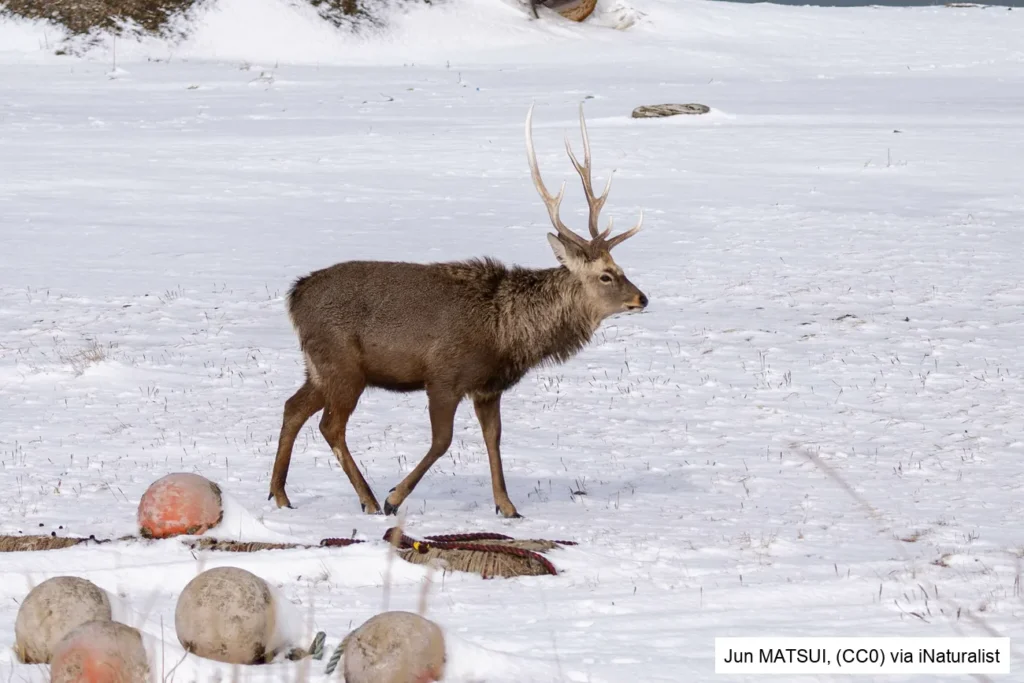
The sika deer is a small to medium-sized deer introduced to the United States from East Asia, where it is native to countries such as Japan and China. It has established wild populations in a few localized areas, particularly along the East Coast and in Texas.
- Quick facts: Often active at dusk and night; known for vocal communication, including whistles and screams during the rut.
- Range: Found in parts of Maryland and Virginia (notably around the Chesapeake Bay), as well as Texas.
- Size / ID guide: Typically 2.5–3.5 ft (0.8–1.1 m) at the shoulder. Recognised by its brown coat, often with faint or seasonal spotting, and a distinct white rump patch. Males have relatively upright antlers with several tines, usually smaller and simpler than those of elk.
Fallow Deer (Dama dama)
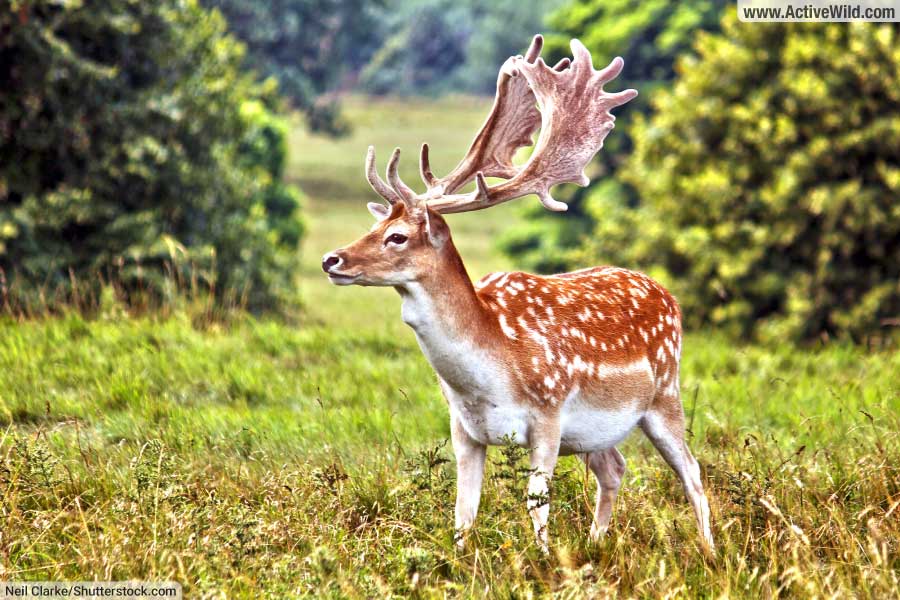
The fallow deer is a distinctive, non-native species introduced to the United States from Europe, now found in scattered wild and semi-wild populations. It is especially common on ranchlands and in managed herds.
- Quick facts: Often active at dawn and dusk; highly adaptable and frequently seen in open parkland habitats.
- Range: Found mainly in Texas and California, with additional localized populations elsewhere.
- Size / ID guide: Typically 2.5–3.5 ft (0.8–1.1 m) at the shoulder. Highly variable in colour, ranging from spotted tan to dark brown or even white. Males have broad, flattened (palmate) antlers that resemble those of a moose but are smaller and more compact.
Red Deer (Cervus elaphus)
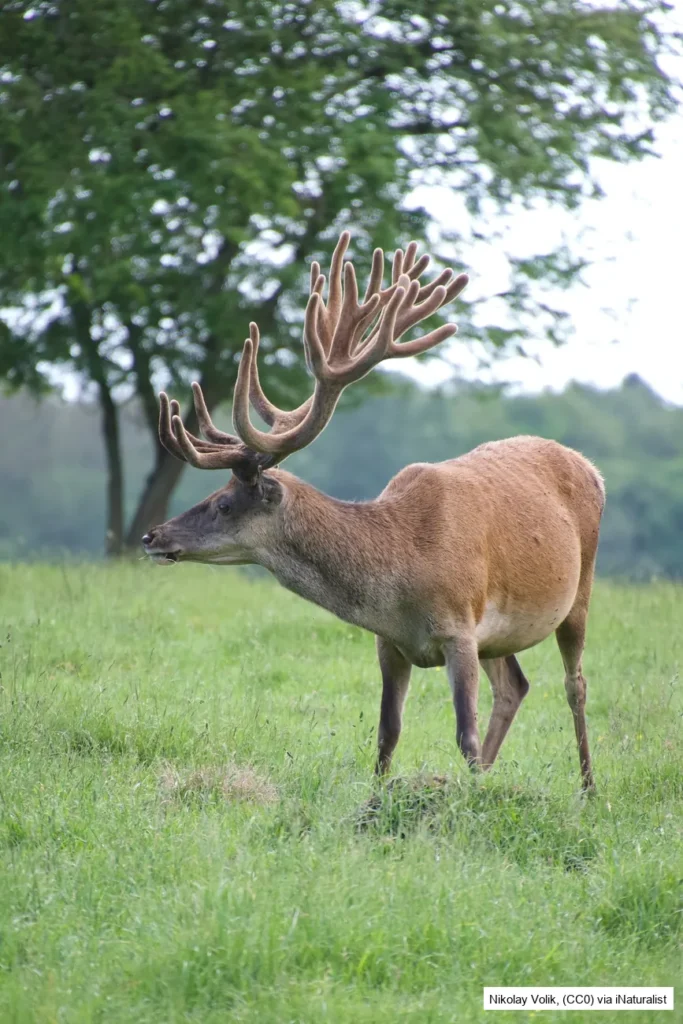
The red deer is a large deer species native to Europe and parts of Asia, introduced to North America in limited numbers. In the United States, pure populations are rare, as many have hybridised with elk.
- Quick facts: Social, often forming herds; males (stags) are known for loud roaring calls during the rut.
- Range: Scattered and limited populations in parts of the western United States, often on private lands or where introduced.
- Size / ID guide: Typically 4–5 ft (1.2–1.5 m) at the shoulder. Similar in appearance to elk but generally smaller, with a reddish-brown coat. Males have large, branching antlers with multiple tines, forming a sweeping, symmetrical shape.
Reeves’s Muntjac (Muntiacus reevesi)
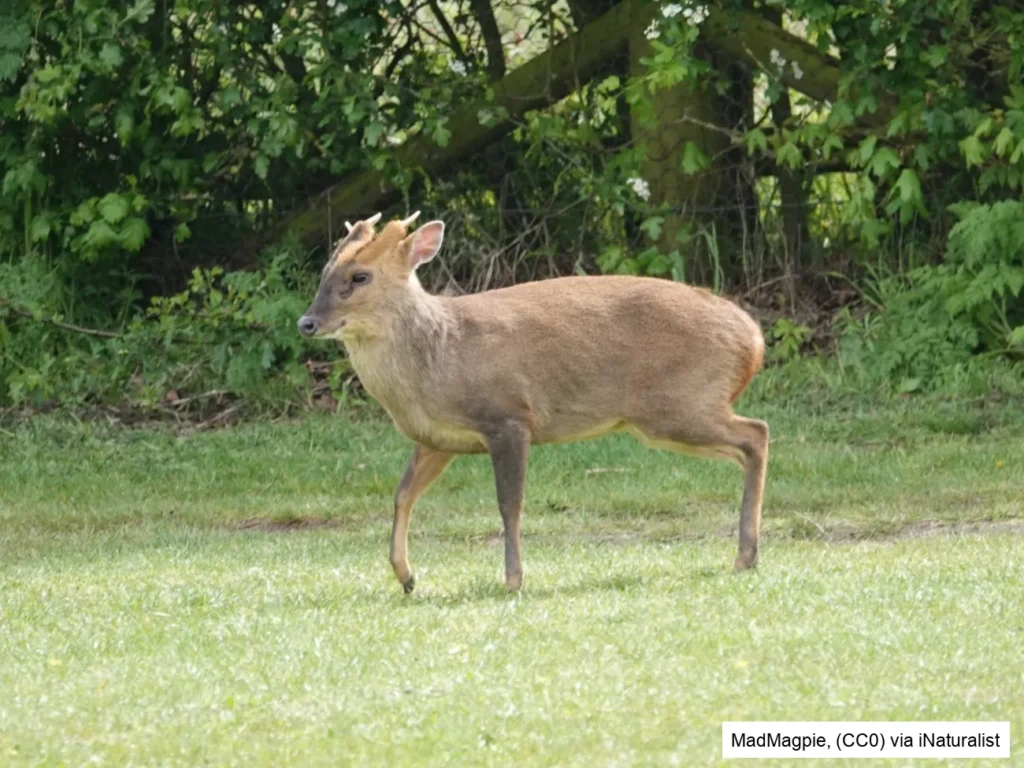
Reeves’s muntjac is a small, non-native deer introduced from East Asia, with a few scattered and localized populations reported in the United States. It is more widespread in parts of Europe but remains rare in North America.
- Quick facts: Mostly solitary; known for its loud, dog-like barking call.
- Range: Small, localised populations have been reported in parts of the southeastern United States.
- Size / ID guide: Typically 1.5–2 ft (0.5–0.7 m) at the shoulder. Recognised by its small size, reddish-brown coat, and rounded back. Males have very short antlers set on long, bony pedicles, along with visible downward-pointing canine tusks used in fights.
Rusa Deer (Rusa timorensis)
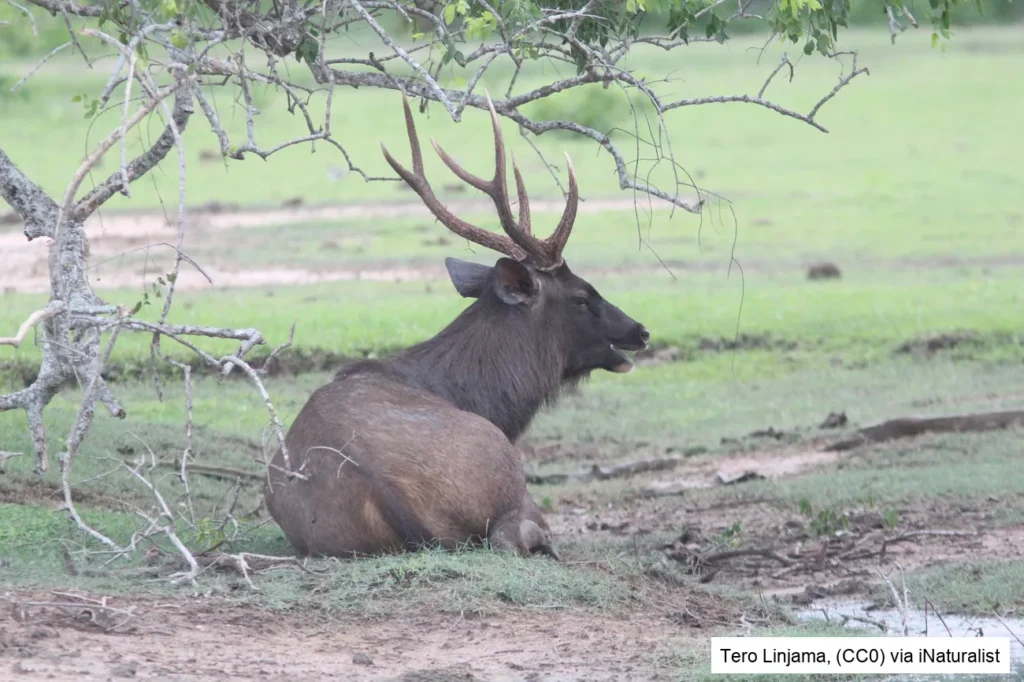
The rusa deer, also known as the Javan rusa, is a non-native species introduced to parts of the United States, particularly Hawaii. Native to Southeast Asia, it has adapted well to tropical environments.
- Quick facts: Often active at dawn and dusk; typically found in small groups.
- Range: Established populations occur mainly in Hawaii.
- Size / ID guide: Typically 3–3.5 ft (0.9–1.1 m) at the shoulder. Recognised by its coarse grey-brown coat, sturdy build, and relatively large ears. Males have three-tined antlers, with a long main beam and two forward-pointing branches, giving a simple but distinctive shape.
Deer Species Found in North America (Beyond the US)
Listed below are types of deer that are found in North America outside of the United States.
Central American Red Brocket (Mexican Red Brocket) (Mazama temama)
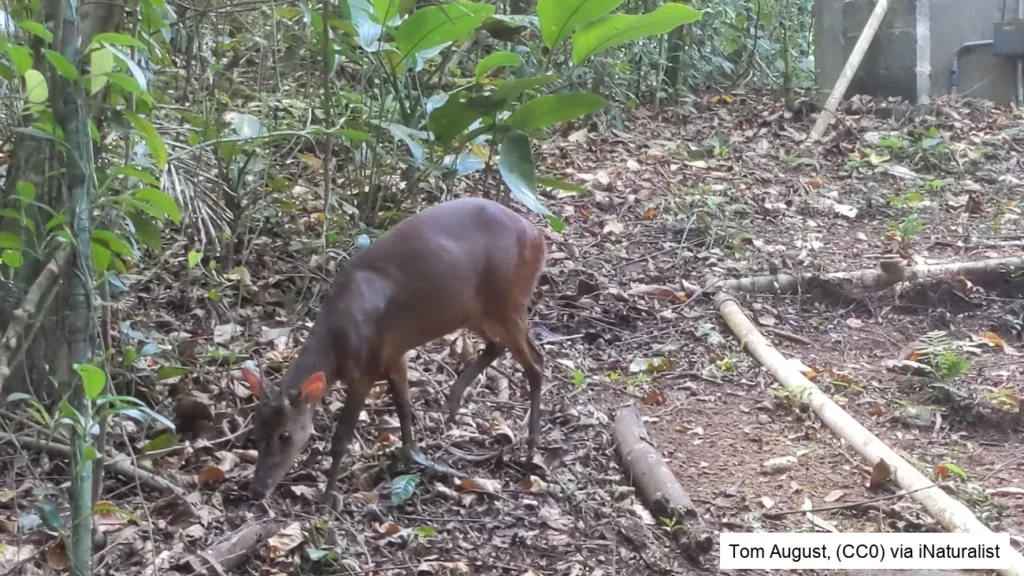
The Central American Red Brocket (also known as the Mexican red brocket) is a small, secretive deer native to the forests of Mexico and parts of Central America. It is rarely seen due to its shy nature and preference for dense vegetation. It is one of several small, elusive brocket deer adapted to dense tropical habitats.
- Quick facts: Mostly solitary; primarily active at dawn, dusk, and night.
- Range: Found in eastern and southern Mexico, especially in tropical and subtropical forests, extending into Central America.
- Size / ID guide: Typically 2–2.5 ft (0.6–0.8 m) at the shoulder. Recognised by its compact body, short legs, and uniform reddish-brown coat. Males have short, straight, spike-like antlers that are usually unbranched and often hidden by surrounding vegetation.
Yucatán Brown Brocket (Odocoileus pandora)
(No image available)
The Yucatán brown brocket is a small, elusive deer native to the Yucatán Peninsula of Mexico. It inhabits dense tropical forests and is rarely seen due to its secretive behaviour.
- Quick facts: Mostly solitary; active mainly at dawn, dusk, and night.
- Range: Restricted to the Yucatán Peninsula, including parts of southeastern Mexico.
- Size / ID guide: Typically 2–2.5 ft (0.6–0.8 m) at the shoulder. Recognised by its compact build, relatively short legs, and brown to grey-brown coat. Males have short, simple spike-like antlers that are unbranched and often difficult to spot in thick forest habitat.
How To Identify US Deer Species: Identification Guide
Identifying deer in the United States is usually straightforward once you know what to look for. The most common species, the white-tailed deer, is recognised by its reddish-brown coat (greyish in winter) and the distinctive white underside of its tail, which it raises like a flag when alarmed.
In the western U.S., mule deer are easy to spot thanks to their large ears, black-tipped tail, and white rump patch. They also move with a unique bounding gait called “stotting.”
White-Tailed vs Mule Deer Habitat Preferences
Habitat-wise, white-tailed deer are highly adaptable, but typically prefer dense, well-covered habitats like forests and farmland edges, while mule deer are adapted to more open, dry, and rugged landscapes such as shrublands, deserts, and mountainous terrain.
Elk are much larger, with tan bodies, dark necks, and large, branching antlers in males. Their size alone often distinguishes them from other deer.
The moose is unmistakable—the largest of all, with long legs, a humped shoulder, and broad, flattened antlers.
Caribou, found in Alaska, have thick coats, large hooves, and irregular antlers (present in both males and females).
Among introduced species, axis deer have permanent white spots, while fallow deer show a wide range of colours and have palmate antlers. Size, antler shape, coat pattern, and habitat are the key features for accurate identification.
Frequently Asked Questions
Are elk deer?
Yes—elk are a type of deer.
They belong to the deer family (Cervidae), which includes animals like white-tailed deer, moose, and caribou. Elk (Cervus canadensis) are simply one of the largest species within this family.
Although they are often referred to separately from “deer” in everyday language, scientifically they are unmistakably deer.
What is the largest deer in North America?
The largest deer in North America is the moose (Alces alces).
Adult males (bulls) can stand over 6.5 feet (2 m) at the shoulder and weigh up to 1,500 pounds (680 kg) or more. Their enormous size, long legs, and broad, palmate antlers make them unmistakable and far larger than any other deer species on the continent.
What is the most common deer in the US?
The most common deer in the United States is the white-tailed deer (Odocoileus virginianus).
It is found across most of the country and has an estimated population of tens of millions, making it by far the most widespread and abundant deer species in North America.
Are there deer in all US states?
Yes—deer are present in all U.S. states, but only 49 have native species, as Hawaii’s deer populations were introduced by humans.
Conclusion
From the familiar white-tailed deer seen across much of the country to the towering moose of the north and the desert-adapted mule deer of the West, the United States is home to many cervids – especially if you add in regional subspecies and introduced species like axis and sika deer.
Deer in North America occupy a wide range of habitats, from dense forests and wetlands to mountains, plains, and tropical islands.
If you have any questions, spotted a deer you’re unsure about, or want to share your experiences, feel free to leave a comment below—we’d love to hear from you!